
Today, I’d like to share another story from the past.
I had an uncle named Michio Kazane. He was a painter.
However, he suffered from a mental illness—I never knew the name of the condition.
When I was a child, we lived in my grandfather’s house. He was a carpenter.
On the first floor lived my grandparents, Michio, and two other uncles who also worked as carpenters helping my grandfather.
My family lived on the second floor.
To the south of the house, there was another two-story building, where one of my carpenter uncles lived with his family..On the east side, there was a road and a space for parking. Between my grandfather’s house and my uncle’s stood a small courtyard, and in that courtyard was a pond about two square meters in size, where koi swam gracefully. On the south side of the building, a sunny veranda offered a view of the pond. I remember the uncles often maintaining their carpentry tools there.
Past the parking lot and courtyard, there was a workshop covered by a corrugated metal roof, where lumber was processed. The space was crammed with timber, and in the center stood a workbench and a small spot for burning wood shavings. From my upstairs room, I often heard the rhythmic clang of hammers, the sharp swish of saws, and the gentle whispering sound of a plane shaving wood.
In a dim corner of that lumber-filled workshop, my uncle Michio had his atelier.
He rarely went outside and hardly ever spoke to anyone outside the family.
He was a completely unknown painter, not part of any group or institution—he simply lived each day painting.
My mother would often whisper harshly, “What does he think he’s doing, wasting his life on something that doesn’t even make money?” But Michio had a gentle soul and was warm and affectionate toward family. He’d crack jokes and make us laugh. I often visited the workshop, and Michio always greeted me with a smile. Even though he was old enough to be my father, I remember having something like a friendship with him.
At the time, I wasn’t particularly interested in drawing, but when I was about eight, Michio gave me my first real lesson.
Until then, I thought drawing was just something you had to do for school assignments.
I’d mechanically fill in sky-blue skies, brown tree trunks, green leaves, gray rooftops, and ochre walls with primary colors over pencil outlines. My drawings never looked right.
One day, I asked my mother what to do, and she said, “Why don’t you ask Michio how to draw?”
Of course—how had I not thought of that?
For once, my mother’s words made perfect sense, and I went downstairs like I always did.
“Hey, Ma-bo,” Michio greeted me with a grin. “Back at the workshop again? Don’t you have homework?”
“No, Michi-chan,” I said. “I actually came to ask you how to draw.”
His smiling face suddenly turned serious. After a moment of thought, in an unusually quiet voice, he said, “Come with me,” and led me to his atelier.
It was my first time entering Michio’s studio.
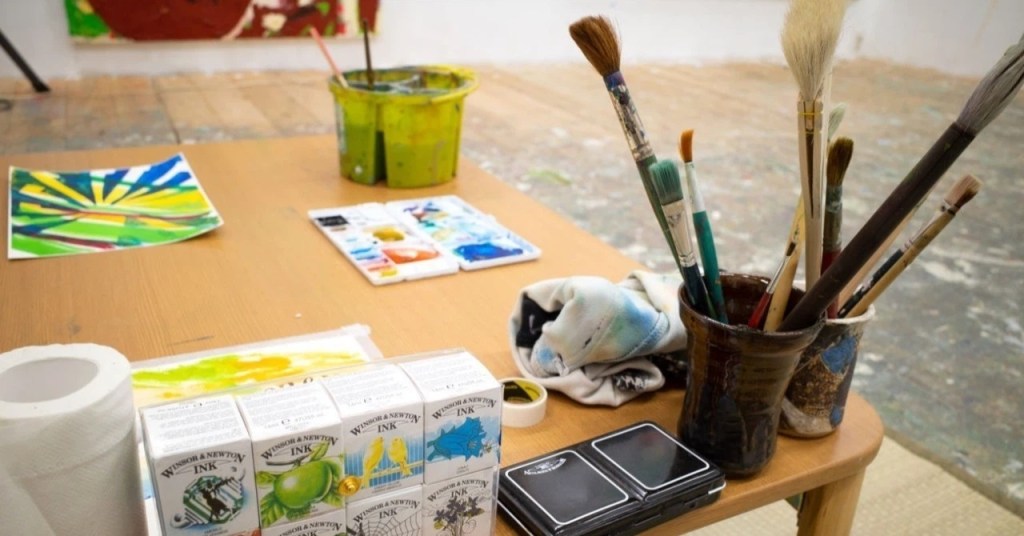
A dimly lit tatami room, cluttered with paint tubes scattered across the floor, leaving splashes on the tatami and walls. Brushes of all sizes, a large palette covered in colors, and painting knives sparked my curiosity.
A wooden easel stood facing the window, holding a half-finished, strangely abstract painting.
Michio liked abstract art.
Sometimes he painted beautiful yellow flowers in a vase, but more often he created overlapping waves of pink, red, and yellow that moved like tides.
I also remember his monochrome paintings—haunting, imagined demons.
“Let’s see what you’ve drawn,” he said, and I showed him a picture of a tree I had seen from the south-facing window on the second floor, standing alone in an empty lot across the street. The tree rose about ten meters high over a concrete wall, thick with early summer foliage.
After studying my picture, Michio spoke quietly again.
“Masato, take a good look at the branches of a tree. When you draw a tree, don’t just lump all the leaves together. Imagine drawing each leaf individually.”
He took out green and yellow-green from my watercolor set, mixed them on a palette, and moistened a brush with water.
“Watch carefully,” he said.
Holding the brush lightly with two fingers near the handle, he began tapping it over the branches I’d drawn.
Each tap left an irregular green dot, overlapping, spreading softly—like leaves blooming along the branch.
I was amazed: That’s it? It’s that simple?
Once he finished one branch, he adjusted the colors for the next, subtly shifting the shade of green.
In no time, my flat green blob of a tree turned into a full tree with leaves swaying naturally.
As I stared in awe, Michio spoke again.
“Masato, look closely at the scenery around you. There’s light in space. Light changes how we see everything. In this drawing, the sunlight is hitting the tree from the upper right.”
He mixed white and yellow on the palette, adding plenty of water, creating a faint, bright yellow.
With that, he gently drew a line down the right side of the tree trunk.
The pale yellow didn’t completely cover the brown beneath, but subtly changed the tone.
I gasped—it looked like light was actually hitting the trunk.
Then he mixed a bit of green into that yellow and added touches of it to the upper-right side of each branch, just like before.
My tree came alive. It was now a great tree full of new leaves, glittering in the summer sun.
I was stunned.
It felt like I had witnessed an ordinary grade-school drawing be brought to life.
From then on, I began to love drawing.
With occasional advice from Michio, I started enjoying my school landscape assignments.
He taught me how to paint clouds, how to capture the sky.
Before I knew it, my drawings were being praised, and the house filled with certificates and awards.
One day at school, a teacher asked us to write what we wanted to be in the future.
While others wrote “astronaut” or “pro baseball player,” I found myself, surprisingly naturally, writing:
“I want to be a painter.”
I’d always been good at drawing buildings realistically.
With detailed lines and Michio’s teachings on light, my landscapes improved.
I drew a new view of the neighborhood from a different angle and showed Michio.
“This is good,” he said. “You could become a background artist.”
At the time, I didn’t really understand what a “background artist” was.
And when I told my parents I wanted to be a painter, my mother strongly objected.
So I had no choice but to give up.
Back then, giving up was the only option I could imagine.
I wasn’t good at expressing myself, and the idea of going against my parents to pursue something I loved never even crossed my mind.
Thus, the path to becoming an artist was closed to me.
But even now, I still have a strong desire to paint.
Michio has already passed away.
He lived his life alone. Thinking of the hardship he must have endured makes my chest ache.
When I write now, some people may notice I express myself a little like I’m painting a landscape.
Michio’s easel is stored in my basement.
A painting of flowers in a vase, bright and full of light, hangs in my wife’s room now.
Whenever I see that painting, I remember Michio’s innocent, smiling face.
When I retire from my job, I plan to take up oil painting again—seriously, this time.
 Canon's Diary
Leave a comment