
On the morning of April 25, a little after 9 a.m., the movers arrived and began carrying out my belongings. Since I didn’t have much and everything was already packed, the two movers loaded everything onto the truck quickly and efficiently. Once they left the house, I promptly began preparing to head to Osaka on my motorcycle.
My father had seen my recent post and declared, “Back when you were in junior high, I wasn’t playing golf—I was just busy.” Oh really? Well, excuse me. I do understand that he was busy. So perhaps it was when I was in elementary school that he played golf? Memory is a vague thing. But what does it matter? Just to be clear, I have no intention of blaming my parents now. That would be utterly pointless. What matters to me isn’t how my father lived his life, but how I felt about it—and it’s that feeling I want to express here.
I left the house just before 10 a.m. The sky was cloudy. Once on the Tomei Expressway, I could feel the chill in the air. Even with a sweatshirt layered on, it wasn’t enough, so I put on the top half of my rain suit to keep warm. Being the day before Golden Week, the roads weren’t too crowded. Though overcast, occasional bursts of brightness appeared as I cruised along. Once outside of Tokyo, everything was green. The Shin-Tomei Expressway, carved through mountains, offered a view of three lanes ahead, and just a glance to the side revealed a dazzling sea of fresh green foliage. The flowing scenery lifted my spirits. Around Gotemba, I caught sight of Mt. Fuji on my right—hazy from smog, but still an imposing presence.
As I rode, my father’s words echoed in my mind, drawing me back to old memories. Back then, I couldn’t express my feelings in words, so I think I needed another outlet. For me, drawing was probably a form of self-expression. Though soccer meant collisions with teammates, frequent injuries, and often unpleasant experiences, focusing solely on the ball, stealing it, and kicking it away was a kind of emotional release for me. I just needed something to immerse myself in. From high school on, motorcycles became another form of self-expression. Letting myself ride with the wind, tilting my head and shifting my hips as I leaned the bike into turns, always keeping my eyes fixed firmly beyond the corner—motorcycling, to me, possessed a kind of artistic grace that cars could never replicate. It felt like a dance.
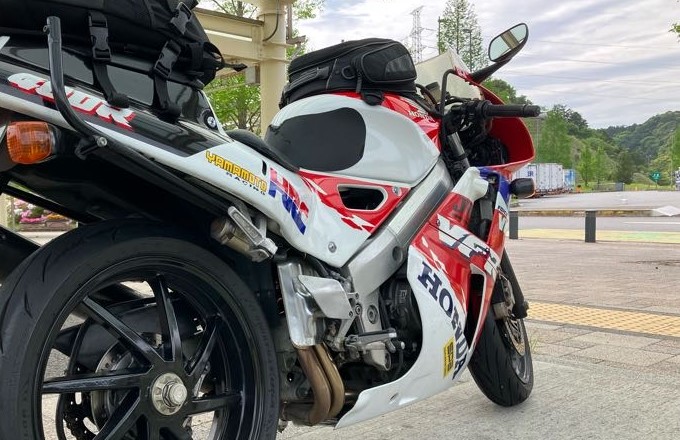
Leaving Naruse behind, today’s destination was Toyoda Town in Aichi Prefecture—a ride of about 284 kilometers. My 1993 VFR400R, with its black wheels and Pro-Arm suspension in OKI racing livery, roared along with a satisfying sound. I took frequent breaks, stopping at almost every service area to refuel and stretch. Along the way, I passed a group of three riders on Honda Rebels several times—we ended up at the same hotel, laughing and exchanging a few words when we realized it. But once in my room, fatigue hit me like a wave, and I fell asleep before I could even enjoy the outdoor bath.
The next morning, while having breakfast at the hotel, a boys’ soccer team in yellow uniforms entered the hall. Two young men who looked like coaches were leading them. The group chatted boisterously.
“I want to eat this meatball!”
“Coach, can we sit anywhere?”
“That’s not garlic, it’s a fava bean. Look closely!”
“Good thing the earthquake didn’t hit yesterday. The prediction was off!”
Each kid said whatever came to mind, participating in the group dynamic.
And I thought: Even if I were a grade schooler again and part of this soccer team, I probably wouldn’t be able to blend in. I doubt I’d be talking freely like that. I could easily imagine myself quietly sitting alone in a corner. I’m over 50 now and have learned the social niceties expected at work, but I still feel that same discomfort when it comes to joining groups. Despite all my life experience, my core self hasn’t changed.
Susan Cain, born in New York, wrote in her book Quiet: The Power of Introverts in a World That Can’t Stop Talking that in many countries, sociable and outgoing personalities are seen as the ideal. But that’s not natural for everyone, and we shouldn’t force ourselves to emulate extroverts. She highlighted the strengths of introverts: deep thinking, strong concentration, and creativity. “You don’t need to pretend to be extroverted. Being quiet is not a flaw—being quiet is a strength,” she said.
Yes, in the end, I’m just not the type to enjoy lively crowds. I’m much more suited to solitary creative work, like art. Michio dedicated his life to painting. My carpenter uncle, in his spare time, carved a stunning wooden Hannya mask as a hobby. Father—you too, instead of talking, devoted yourself to the guitar. The Kazanekas are an artistic family. This isn’t about upbringing or parental education. This is simply how I was born.
On Saturday, the second day of my trip, the sun was already shining in the morning, and the temperature was high—I had to choose my clothes carefully. After checking out and heading to the bike parking area, I saw that the Rebel group had already departed. I left the hotel, stopped by a convenience store, filled my thermos with hot coffee, and headed toward the entrance to the Shin-Tomei Expressway. At this pace, I should arrive in Osaka by around noon today.
 Canon's Diary
Leave a comment