
◆A Calm Afternoon in Kugenuma
On April 29, I had plans for a barbecue at a friend’s house near Kugenuma Beach. After taking the Odakyu Line and getting off at the station, the scent of the Enoshima sea greeted me. Though the sea wasn’t visible from the narrow residential streets, the atmosphere of a seaside town was palpable: people heading to the beach with surfboards attached to their bicycles, women holding down their straw hats against the breeze, and families walking with inflatable rings in hand. The blue sky of May stretched endlessly above.
My friend’s house is situated along the estuary flowing into the Enoshima sea. The spacious living room, with its open design, leads seamlessly to a terrace connected to the garden. In one corner of the lawn, a barbecue grill was set up. This time, six friends of similar age gathered. Though nearing retirement, each was enjoying a leisurely life, and our conversations flowed effortlessly—from health and family matters to politics, economics, and business. A mixed-breed dog, part Chihuahua and Toy Poodle, resided in the house. When I reached out, it approached, wagging its short tail briskly.
It’s only recently that I’ve come to enjoy such peaceful moments. Perhaps it’s a feeling of having finally relaxed. Until now, my life as a working adult felt like a survival competition, always on edge, constantly wary of my surroundings. My values have shifted; I’ve become more attuned to society. The notion that I was someone special, raised in an underprivileged environment, has faded. I’ve learned to forgive my occasional laziness. In the past, I was perpetually tense.
◆The Battlefield Named Entrance Exam Study
I failed my university entrance exams in my third year of high school and began a year as a rōnin (a student preparing for re-examination). Attending a preparatory school, my days were consumed by study—a routine that, in hindsight, was extreme. I’d wake up, eat a slice of toast, ride my motorcycle from home to Yoyogi, park on the sidewalk beside the prep school, and attend classes. During lunch, I’d have a regular-sized beef bowl at Yoshinoya. Afternoons were filled with more study. Upon returning home, I’d eat dinner prepared by my mother, watch my favorite TV show for 30 minutes (Dragon Ball was popular then), and then seclude myself in my room to review the day’s lessons and prepare for the next. I’d usually go to bed past 1 a.m. This cycle repeated daily, mechanically, without much thought. Monthly mock exams at the prep school allowed me to gauge my progress. I had discarded all emotions, suppressing myself entirely. I was accustomed to this suppression, driven by the belief that if I didn’t give my all now, when would I?
I appreciated mathematics for its lack of emotional interference and singular answers. As I progressed, patterns in the problems became evident. By memorizing these patterns, I managed. Physics was similar. Though I struggled during my active student days, recognizing patterns made applying them smoother. For these two science subjects, I adopted a strategy of pattern memorization rather than theoretical understanding. I meticulously maintained my notebooks, using rulers to keep them neat. However, I struggled with Japanese language comprehension, unable to grasp the author’s feelings or read between the lines. While social studies had many memorization elements I excelled at, I couldn’t internalize the sentiments of historical figures or societal rules, making it challenging. English, being a straightforward memorization subject, saw my grades improve proportionally to my study time. Consequently, I chose to pursue a science-oriented university.
◆A Fractured Heart, Yet I Walked On
Science—what kind of jobs does that entail? I had no mental space to ponder such questions. By this time, my heart was likely already broken. I had become someone who couldn’t understand others’ feelings. I spent a lot of time alone, which, in hindsight, meant I experienced less stress from interpersonal relationships. The monster within me remained dormant. In January 1986, the tragic news of the Challenger space shuttle disaster, where seven astronauts lost their lives, was broadcasted. Seeing that, I thought, perhaps becoming a rocket launch engineer, dealing with mechanical and physical aspects, would be suitable. But now, I realize that wasn’t my true desire. I wasn’t particularly interested in rocket development; I merely attached an ideal future image, influenced by a shocking event, based on my current academic trends and how I wanted others to perceive me. It was a foolish delusion, a kind of self-hypnosis. A fragility of heart born from youth.
I almost entirely cut off interactions with friends. I believed that conversing with others would introduce distractions, hindering my studies. That year was solely focused on improving my academic abilities. I compiled my monthly mock exam results into graphs on graph paper to track progress over time. A peculiar pattern emerged: months of poor performance alternated with months of significant improvement. I couldn’t understand why. While English grades improved consistently, physics and mathematics displayed this alternating trend from April to December. In April, I targeted universities like Meiji, Chuo, and Aoyama Gakuin. I excluded Waseda and Keio due to the increased number of exam subjects. With only a year, I believed adding more subjects would spread my time too thin. The mock exam results just before the actual exams were poor. Analyzing the trends, I anticipated better performance in the next exam. Thus, I chose Chuo University, which had a convenient schedule and was close to my first choice. For subsequent exams, I alternated between universities I had low and high desires to attend, adjusting the schedule accordingly. In the two days before the actual exams, I reviewed all the notes accumulated over the year, organizing the question patterns in my mind.
◆The Actual University Entrance Exams
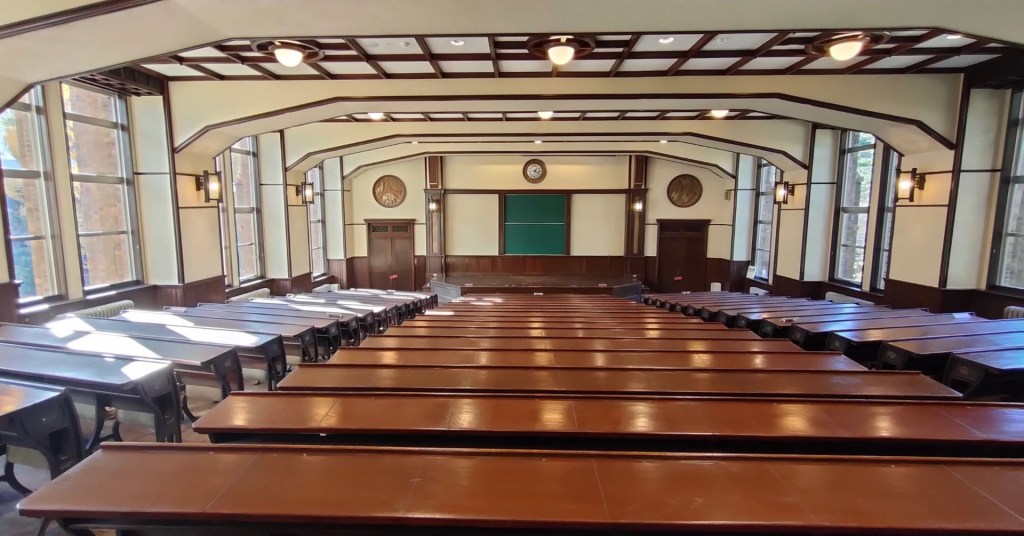
I still recall the sensations of the exam day. I remember Chuo University’s acceptance rate being over ten times. Wearing a black student uniform with a large jumper over it, I entered the exam hall and took my seat corresponding to my number. The winter auditorium was filled with crisp, clear air. Looking around at the others, I thought, only one in ten here will pass. Swallowing dryly, I reminded myself that, being not particularly smart, I had to study ten times harder than others. I had endured a year of hardship for this day.
I was too scared to check the acceptance results in person, so I opted to have them mailed. Receiving the envelope from the university, I secluded myself in my room and, with trembling hands, opened it. Upon finding my exam number among the documents, I couldn’t help but jump on my bed and shout with joy. Even my parents, who had assumed it was hopeless, were surprised and overjoyed. Subsequent exam results mirrored the trends from the mock exams. Regardless of the university’s difficulty, the pattern persisted: passing Chuo University first, failing Aoyama Gakuin next, then passing Kanagawa University. I achieved my first-choice admission to Chuo University. I remember my uncle Michio saying, “Alright, your life is secured now.” For the first time in my life, I felt, “I’ve won.”
However, in retrospect, it was a perilous gamble—suppressing myself to study like a machine. I poured everything from my immature heart into it. I had considered whether I could endure another year if I failed after this year as a rōnin, but instinctively knew I couldn’t. My heart was already at its limit. The thought of not passing sends chills down my spine. If I hadn’t passed then, perhaps…
This is the continuation of my reflections on my university entrance exam experience.
Through this exam, I may have taken my first step from a passive life to one of proactive action. The day I received the news of my acceptance, my heart leapt with joy. But by the next day, I had already calmed down. I felt a deep sense of relief, as if all the tension in my body had suddenly loosened, and I spent the next few days sleeping heavily.
In the two months before enrollment, I found myself thinking about what kind of university life I wanted to lead. The fact that I had passed the exam became a major source of confidence for me—a person who had always lived quietly, belittling himself in the corner of the classroom.
Perhaps now I could live with my head held high. Perhaps I was equal to everyone else.
I believe it was during this time that I began to feel that way.
However, it still took me a long time to truly accept myself. Just because I had passed the entrance exam didn’t mean that anything fundamental about me had changed—and later, I would come to realize this painfully.
As for my recollections of university life, I will share those another time.
◆Now, sitting on a bench and looking up at the sky
I left the barbecue gathering around 3 p.m. and boarded the Odakyu Line bound for Machida Station. I had dinner plans with another tennis group later in the evening. Since it was still early—well before our 6:30 p.m. meeting—I decided to stroll around the streets of Machida for a while.
I browsed through some vintage clothing at a second-hand store, and stopped by a shoe shop looking for a pair of black high-top Converse. But as I grew tired from walking, I sat down on a bench along Chuo Street and started writing this post.
It was a sunny afternoon with a pleasant breeze.
Stylish young people dressed up, student club groups, parents and children walking hand in hand, staff promoting phone contracts, the sound of car engines, and a city council member giving a street speech—
The usual everyday scenes.
And yet, for some reason, today they felt special.
Unchanging memories of the past remain only in the hearts of those who lived them.
How we choose to interpret them—that is entirely up to us.
 Canon's Diary
Leave a comment