
◆ A Quiet Dawn of Everyday Life
On April 26, I drove down the expressway and arrived in Osaka. I stopped by a real estate agency near Takatsuki Station to pick up the keys to my new apartment. With the help of my GPS, I rode my motorbike to my new home near Tonda Station. I had already signed a monthly parking contract for my bike. The shopping street that stretches from Hankyu Tonda Station to JR Settsu-Tonda is packed with small shops — supermarkets, drugstores, izakayas, restaurants, gyms, and even a takoyaki stand. Everything necessary for daily life seems to be there. I could constantly hear the sound of Hankyu trains passing through.
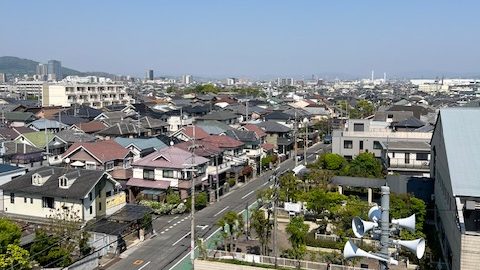
My new apartment is on the sixth floor. I unlocked the door, stretched a bit in the empty room, and took a deep breath. Through the east-facing window, I could see the sunlit tiled rooftops of Tonda Town. Below, there’s a pond called Kodera-ike, alongside the Takatsuki Municipal Library. The surface of the water glistened and sometimes rippled widely. Though invisible to the eye, I sensed the presence of ducks or other wildlife. A feeling of “let’s begin again” welled up inside me. I was grateful to feel this calm. The inner monsters—anxiety, loneliness, unspeakable unease—no longer haunted me. In the past, I had to release myself through soccer, motorbiking, or tennis just to maintain emotional stability. Over many years, I’ve finally reached this peaceful state.
◆ The Cage of Prayer and the Voice Within
I must have been in upper elementary school when I began to feel a strong discomfort toward the religion my mother practiced and taught. Until then, I believed that all children, like me, chanted sutras at home, recited prayers, attended gatherings, and shared personal experiences. But I realized that wasn’t the case—others were far more free. They said “no” when they meant it, spoke their minds, expressed themselves—even argued. I tried to mimic them to some extent, but something always felt off. I once asked my mother why other kids didn’t chant, and she replied curtly, “That’s them. We’re us. They don’t matter.”
While I was taught compassion and the importance of prayer, I felt my individuality and personality were being erased. Crushed by inexpressible anguish, I finally told her:
“I don’t want to do this anymore. No one else is doing it, and it only brings me pain. This religion has been suppressing my feelings for so long. I want to tear up the sutra book and burn it.”
Her eyes changed.
“You can’t do that,” she said. “If you do, nothing but misfortune awaits you. If you tear it, your body will be ripped apart. If you burn it, you will be engulfed in flames and die. The reason your heart hurts is because you lack prayer.”
◆ The Sinfulness of Humanity and the Role of Religion
Today, I think I can understand the teachings of Soka Gakkai. The idea is that each of us harbors Buddha within, and chanting the daimoku is a way to resonate with one’s soul. Even in times of hardship, by chanting and stoking the flame of life, one gains inner strength.
Still, I believe that humans are inherently sinful. There are no such things as Buddha-like people. From the moment we are born, we cry and cause disruption. We eat the lives of animals and plants. We wage war. We destroy nature and build concrete cities. We are deeply selfish beings. We’ve even driven the Earth to the brink with greenhouse gases and global warming. Have you seen the footage of a whale, burdened by barnacles, seemingly pleading with humans for help? To me, the barnacles look like humanity, and the whale like the Earth itself. When I see aerial footage of skyscrapers in big cities, I feel a chill — as if the Earth is silently crying out to be freed. But humans cannot stop their selfish ways. We live with the burden of sin.
◆ The Day I Opened My Heart’s Cage
And yet, we have reason. When we do wrong, we feel guilt. Religion can help cleanse that suffering, strengthen our reason, and teach us to be grateful for those around us. Soka Gakkai is one such example. By chanting the daimoku, one resonates with the Buddha within, releasing inner pain and purifying the soul. I now understand its strength — not relying on a transcendent force, but focusing on self-powered enlightenment. It is, in essence, a powerful and admirable belief system.
But to the child I once was, the compassion and prayers I was taught felt like a curse. I was told that the world is governed by love and justice, but there are emotions in human nature that such ideals cannot explain. Having repressed myself from birth, I became distorted. A monster began to inhabit my heart, trapped within the walls of compassion and prayer — and eventually, I could no longer contain it. I had no choice but to walk away from religion. Letting go of its framework was no easy task. It took countless years to rebuild my identity and cast out the monster. But once I let go, I could finally breathe. I could speak with my own voice and see my life in my own light. I never rejected faith itself—I simply chose a freer path. That, for me, was healing.
◆ A Prayer of Gratitude Held in My Hands
As I unpacked the boxes brought into my apartment, I bundled up the cardboard and took the garbage out. Today, the single bed I had ordered from Tokyo was delivered. Slowly, my new life in Osaka is taking shape. Amid the mountain of boxes, I ate a store-bought lunch. I’ve recently begun putting my hands together in gratitude before meals. Curiously, my mother never taught me this. In my family, we were never taught to fold our hands before eating, nor were we taught the proper customs for Obon or visiting graves. Having stepped away from religion, I still remember the sutras but know little of basic Buddhist customs. When I married my wife, I remember how surprised she was.
Even so, I’ve decided I want to learn this habit — folding my hands before meals to express gratitude to the living beings that gave their lives. Only now do I finally understand how natural and meaningful that is. I think I’m getting better at it lately — what do you think?
 Canon's Diary
Leave a comment