
◆ Shibuya in Flux
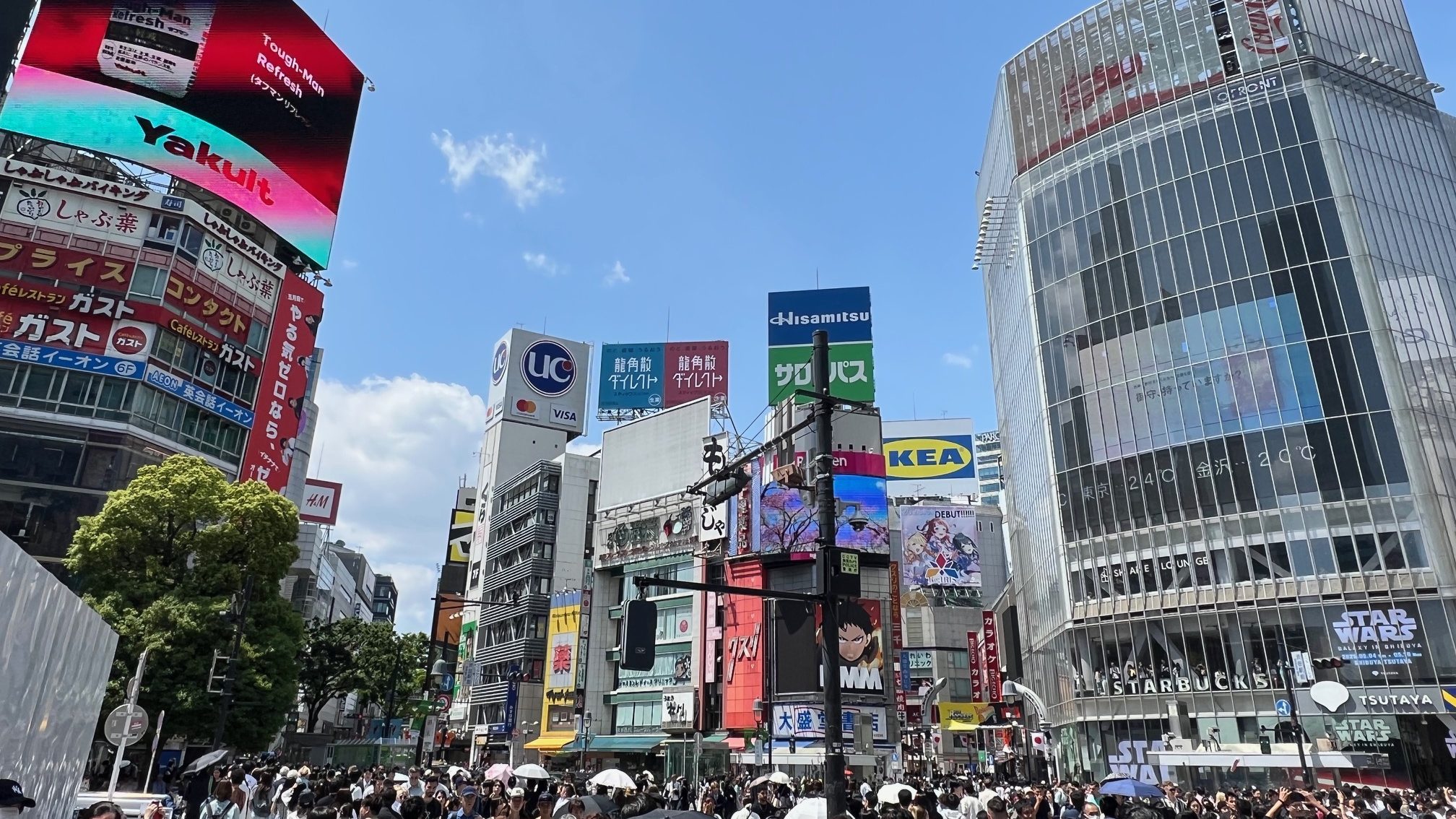
May 5th. I visited Shibuya for a lunch gathering with my old friends from Tokyo Metropolitan Hiroo High School. Around midday, the station was bustling with young people and foreign tourists. Luckily, the weather was clear—important, as I had planned to walk to my alma mater southeast of the station afterward. Towering buildings under a flawless sky, massive LED screens flashing advertisements and lights, and lines of people waiting to snap photos in front of Hachiko. Shibuya isn’t a “completed” city. Construction continues everywhere. It’s constantly evolving. From the Yamanote Line platform, the view is more of a construction site than anything else—unchanged for years. It seems Shibuya’s final form is to remain ever-changing.
We were to meet at the Moai Statue at 1 p.m.—once, alongside Hachiko, one of Shibuya’s iconic meeting spots. Now it’s been moved to a quieter corner near Route 246, and I felt a pang of nostalgia. There were six of us—friends close enough that we no longer needed small talk. I arrived a little early, leaned against the railing, and sipped coffee from a flask. Memories of high school came flooding back.
◆ Lost in the Name of Freedom
What would I do with my life? After my dream of becoming a painter had died, I had no clue. I barely spoke to my parents. I didn’t follow the news. I simply lacked information. I chose Hiroo High only because my father had attended it. Perhaps because of its location, it had a very polished and liberal atmosphere. There were no strict rules, no uniforms. Some students came wearing black leather jackets and carrying electric guitars—no one objected. That freedom became part of the school’s vibe.
It wasn’t an academically intense school, so there was no real pressure. And by high school, even the rebellious types mellowed out. Everyone enjoyed cultural activities in their own way—sports, art, music. But perhaps that freedom made me anxious. I didn’t know what to do with it. I had few friends, largely due to my own social awkwardness.
◆ Conversations with an Engine
Due to its urban location, the schoolyard was small—barely half a soccer field. It was shared among various sports teams. I stayed in the soccer club, but it felt more like punishment than passion. It wasn’t that I disliked my teammates. I simply couldn’t break into the circle. I feared being seen as “that weird guy.”
Around that time, I began commuting on a 50cc gear-shifting moped. The road from Komazawa University Station to Shibuya—Route 246—was packed with aggressive drivers during the morning rush. I weaved through cars, rode recklessly. Perhaps I was trying to shake off my self-loathing. The motorcycle became something sacred. When I twisted the throttle, it accelerated. When I hit the brakes, it stopped. When I turned the handlebars, it responded. I couldn’t talk to my classmates, but I could talk to my bike.
With the exception of a few close friends, I bonded more with that engine than with people. It soothed my loneliness.
◆ Reflections of Inferiority
I remember once saying, “Bikes are alive,” and watching classmates recoil in awkward silence. That was also when I started hanging out at arcades. I didn’t know who I was or what I wanted. I drifted through each day.
I probably spent a lot of time comparing myself to the cool, popular students—the entertainers who fired up the crowd at the school festival rock band, or the tall, handsome volleyball captain. I didn’t crave recognition per se, but I’d gotten into the bad habit of comparing myself to others.
◆ A Voice I Want to Believe, a Feeling I Want to Reject
University entrance exams loomed large, but I didn’t think about them much back then—honestly, I’d already given up. I figured I could try again after a year off. My mother wanted me to go to Soka University, but by then, I was openly resisting religious activities. We argued constantly, and it felt like my parents had given up on me.
I didn’t want to rely on them anymore. I wanted to stand on my own. But I still had no idea how. I just understood that I needed to get into the best university I could manage.
Unsurprisingly, I failed all my entrance exams that year. But I didn’t feel crushed. It was like, “This was always the plan.” I’ll share more about my gap year some other time.
◆ The Road to My Alma Mater
After the reunion lunch, we all headed southeast. The same path I took to school every day back then. Just a little ways from the center of Shibuya, the city gives way to quiet residential neighborhoods. The old arcade had become a Chinese restaurant. The candy shop where I used to buy ice cream was now a barbershop. Still, the familiar school route remained, and I walked it again with old friends.
Hikawa Shrine, which we passed along the way, felt like stepping into a mountain forest—an oasis of lush green in the heart of Tokyo. We chatted freely, carefree. When I shared how the freedom of those days had scared me, my friends admitted they’d felt the same, more or less.
I’m grateful for these friends—people who’ve stayed in my life without any ulterior motives, untainted. In ever-changing Shibuya, an unchanging friendship quietly gave me a push forward. That’s what kind of day it was.
 Canon's Diary
Leave a comment