
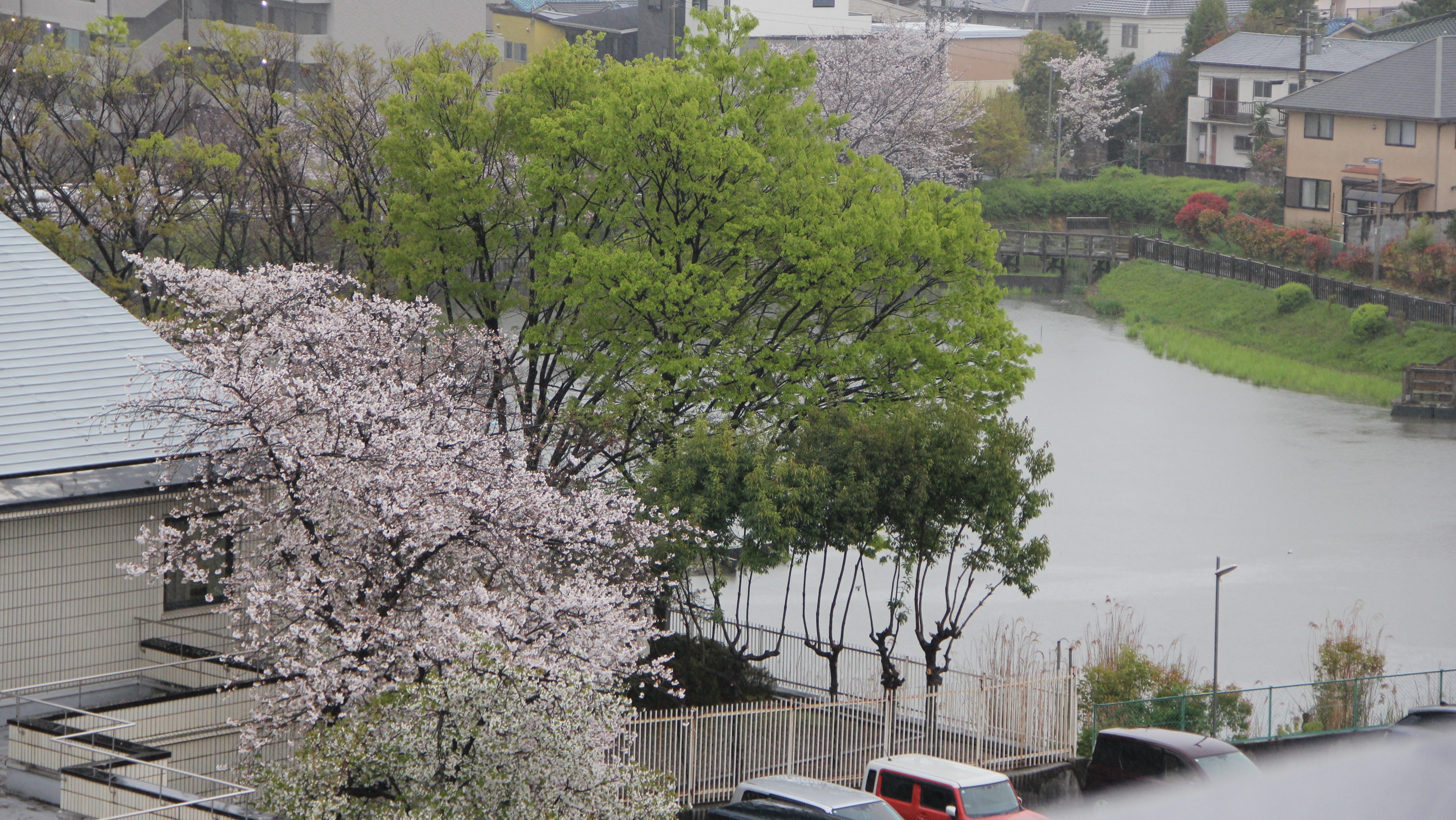
With each passing day, the warmth deepens, and the arrival of spring makes itself felt. Yet today, of all days—a long-awaited Saturday—the light morning drizzle had turned into steady rain by noon. I hurried to bring the laundry in from the balcony. By now, the cherry blossoms should have been in full bloom.
As I boiled soba for lunch in the kitchen, the east-facing window gradually fogged over, turning milky white. The temperature was low for this time of year, and for the first time in several days, I switched on the air conditioner.
Work had piled up to a tiresome degree, but I had no desire to open my company laptop today. After finishing my meal, I took a sip of freshly brewed coffee and gazed out the window. People walked by under their umbrellas. The pavement was soaked, and each passing car sent up the sound of water scattering. Kodera Pond, visible to the southeast, lay dappled with ripples as raindrops spread across its surface. A few cherry trees stood around the pond, their blossoms drooping, appearing somehow forlorn. Nearby, white flowers bloomed close together—perhaps kobushi (Japanese magnolia), or maybe hakumokuren (white magnolia).
Turning away from the window, I moved to sit in the living room chair, but the room felt dim, so I switched on the light. I didn’t feel like going out today. My 1993 Honda NC30, parked at the nearby rented lot, remained covered in a black rain sheet, droplets falling steadily onto the ground. On days like this, not having a car feels inconvenient. I had been looking forward to seeing the cherry blossoms in full bloom, and even thought of going to the nearby Uniqlo to pick up a spring hoodie, but I gave up on the idea and decided to stay in.
I opened my MacBook and scrolled through the news on Nikkei. It was reported that President Trump had stated the attacks on Iran would conclude in about two weeks. There were also remarks suggesting Iran was seeking dialogue for a ceasefire, though the truth remained uncertain. Iranian authorities issued statements contradicting Trump’s claims. Yesterday, news came in that a U.S. F-15E fighter jet had been shot down by Iranian forces. Iran appeared prepared to continue its full resistance against the United States. More than a hundred American international law experts have pointed out that the military actions initiated by Trump “clearly violate the UN Charter and may constitute war crimes.”
What, then, has Trump—under the banner of MAGA—brought about? Large-scale tariffs on exports to the United States, the capture of Venezuela’s president, claims over Greenland, policies prioritizing fossil fuels in opposition to global efforts against climate change, and now military action against Iran. The international order is trembling. Surely, many are aware of this. At the very least, it is hard to deny that his influence looms large over the current chaos.
Dear American friends—once, Japan launched a surprise attack on the military facilities at Pearl Harbor, taking 2,400 lives. The Second World War followed, and in the end, the United States dropped atomic bombs on Hiroshima and Nagasaki. In Hiroshima, 140,000 perished; in Nagasaki, some 70,000. Few remain today who experienced those days firsthand. Our generation, raised without knowing war, grew up even harboring a sense of admiration for America. And yet, I want to ask you now: what is it that he is doing? Do you truly believe this is right? When I look back on the history between Japan and the United States, conflicting emotions inevitably arise.
After the war, America became the world’s police—guardian of the international order—strengthening its military while expanding its economy. The night skyline of Manhattan, Hollywood films—America once shone brilliantly in my youth. Or perhaps, in truth, it only appeared that way. Meanwhile, defeated Japan renounced the creation of nuclear weapons. There seemed to be, in that decision, a quiet sense of atonement as a participant in war. Since then, though poor in natural resources, Japan has continued its development through intellect and technology, speaking little, as if keeping its heart closed.
“Japanese people are hard to understand”—I recall hearing such things said. Over the eighty years since the war, our two nations have been called steadfast allies, yet perhaps the sentiments of their people stand in contrast, like light and shadow. Looking back now, I cannot help but feel that the version of myself who once admired America was simply naive, ignorant of the world. I spent nine years working for a German-owned company, and from a certain ideological perspective, I find myself wondering whether Germany might be a more fitting partner as a friend. It is a thought that comes to me, almost unexpectedly.
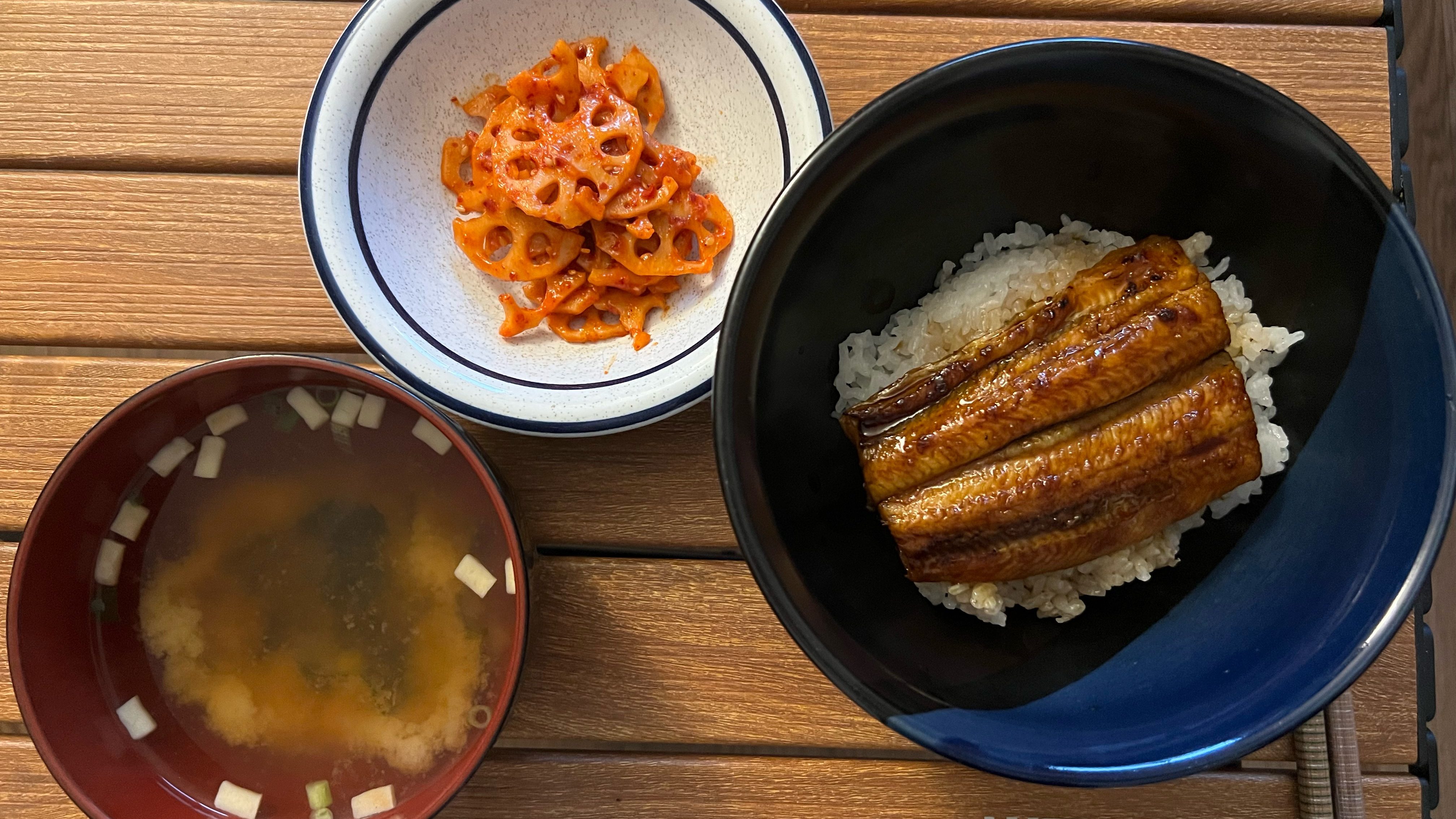
As evening fell, I began preparing dinner. Grilled eel, obtained through a hometown tax program, accompanied by instant miso soup and lotus root kimchi I had bought the day before. I warmed the eel in hot water for a couple of minutes, then lightly crisped the surface in a toaster. This gives it a delicate contrast—crisp on the outside, tender within. The sauce was not overly strong; the balance of soy-based saltiness was just right, mellow and satisfying.
Yesterday, there was news that a heavy oil tanker from Mitsui O.S.K. Lines had passed through the Strait of Hormuz. It was the first Japanese-registered tanker to do so since the route had been effectively closed due to rising tensions around Iran. Perhaps the situation is, little by little, moving toward calm. Will the turmoil in the global economy settle in a few weeks’ time? According to the forecast, the rain will stop tomorrow, and the skies will clear. I may be able to go out and see the cherry blossoms in full bloom—if today’s rain has not already scattered their petals.
For now, though, all I can do is stay inside and wait for the rain to pass. It feels no different from quietly watching the uncertain course of this country—and of the world—as it unfolds. In truth, perhaps the one I should be questioning is not them, but myself, who can only sit here and observe.
 Canon's Diary
Leave a comment