Canon's Diary

Action without thought is empty; thought without action is blind – Goethe

While living with schizophrenia, I move between Tokyo and Osaka. Through this journal, I hope to quietly share moments from my daily life—and memories from the journey I’ve taken with my illness.

  • Sunday, August 24, 2025.
    I just finished dinner and I’m now in my apartment in Osaka. During the day, the temperature soared above 36°C, but around 7 p.m., as darkness fell, the sound of rain began, soon followed by rumbling thunder. Since I haven’t drawn the curtains, the lightning flashes reflect strongly across my dimly lit room, colored by the warm glow of an incandescent bulb. And yet, instead of fear, I feel a sense of relief—the long-awaited rain has finally come.

    It’s been a while since I last posted. Please forgive me. I was overwhelmed with work, and the stress affected my autonomic nervous system, leaving me unwell and in need of rest. What follows are fragments from my personal notes during my absence. I have many such records, and I’d like to use them as a way to gradually resume posting.


    Wednesday, July 16, 2025.
    From early morning, cicadas have been crying. Around Kodera Pond and the library lies a small forest, an ideal habitat for them. Opening the window made their chorus even louder. The morning was sunny, but by afternoon the wind grew stronger, and thunder rolled from time to time, bringing unstable weather. Lately, the climate shifts so rapidly. During such times, my autonomic nervous system easily falters, leaving me feeling unwell.

    At work, I had four projects that needed to be handed over to the design department. Yesterday, I held a meeting with them and successfully transferred all four. I also completed the technical documentation. Now, as long as I support the exchange of information between clients and designers, the projects should proceed smoothly. Next week, I’ll return to Tokyo for some administrative errands, so I wanted to clear up the more time-consuming tasks beforehand. It’s a relief to have managed that. This morning will end with an internal meeting in the department.

    For lunch, I had spicy chige soup and a glass-noodle salad at the company cafeteria. In summer, with salt easily lost through sweat, I often crave spicy food. I think the reason I enjoy project management is deeply tied to my college days working as a waiter.

    My experiences at the Kabukicho branch were bitter at first, but after completing training, I began working as an opening staff member at a new restaurant near Machida Station. The place was in the basement of a building—its ground floor occupied by Kumi-do Bookstore—operating from 9 a.m. to 9:45 p.m. I took customers’ orders, relayed them to the kitchen, prepared coffee and parfaits, fetched cakes from the showcase, delivered dishes, handled complaints, changed water glasses, cleared plates, and supported customers until they left satisfied. A waiter serves as the bridge between the restaurant and the guests. Entering university so naïve about the world, this part-time job became my true education in society. In many ways, it parallels what I do now as a project manager.

    For someone like me, raised with lessons of mercy and prayer but lacking social resilience, working as a waiter was the best possible choice. It was a job of service, where good deeds translated directly into customer satisfaction. Extending a hand to those in need—whether by serving food, picking up a dropped fork, or cleaning up a spill—mirrored the same spirit. Above all, the words “Thank you” brought me the deepest joy. They made me feel that I was genuinely useful to others.

    Of course, it wasn’t all pleasant. Training was strict. The floor manager, once part of a biker gang, was hot-tempered and sometimes grabbed me by the collar as if to strike me. Yet, as an inexperienced student, I truly had countless things to learn about social life. Though quick to anger, the manager was also deeply human, and he hammered proper manners into me.

    Since I had daytime classes, I usually worked shifts from 5 p.m. to closing at 11 p.m. on weekdays, and from 2 p.m. to 11 p.m. on weekends. I walked the floor nonstop, cleaned the restaurant after closing, and scrubbed the kitchen with a deck brush. With little money or time for meals, I often survived on just a cream puff sold at the store. My weight dropped to 58 kg, yet I felt oddly suited to the job. Somewhere deep inside, I believed: if I stay here, I’ll learn something valuable.

    Though I was often yelled at by chefs and full-time staff—terrifying at the time—looking back, I feel I must thank them.


    The rain and thunder still haven’t stopped. In fact, last Thursday, I came down with COVID and spiked a fever of 38.9°C. I went to the hospital, received antipyretics, and my fever subsided in about two days, but I still cannot return to the office until Tuesday. The news has been reporting a surge in COVID cases lately. I plan to work from home on Monday, but for now, I simply want to rest while listening to the sound of the rain.

  • Tuesday, July 15th.
    Because of the rain yesterday, the morning air was cool. The sky was lightly overcast, but the forecast said it would turn into scorching sunshine by afternoon.
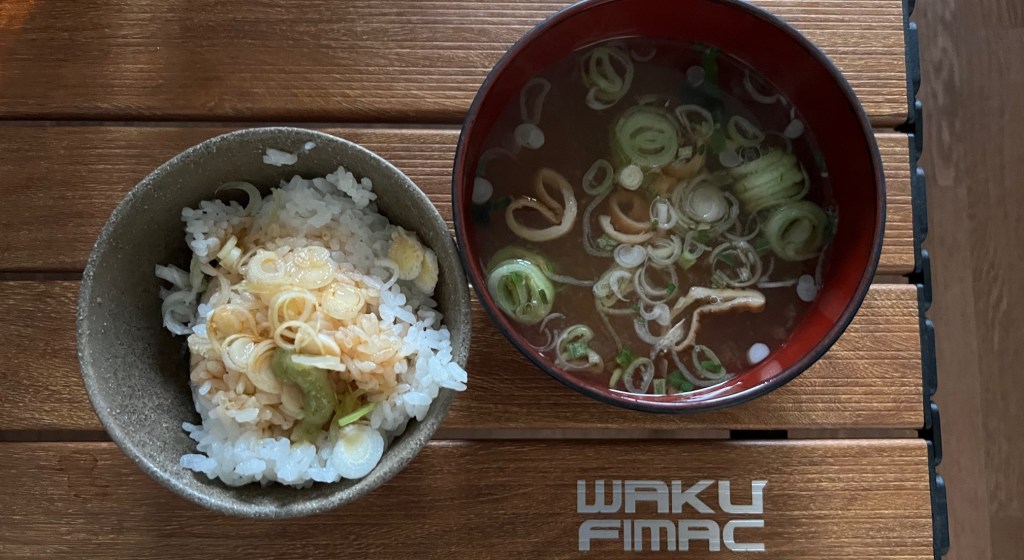
    Last night, I cooked about two cups of rice, so this morning I enjoyed green onion soy sauce rice with miso soup.

    It’s been two and a half months since I moved to Osaka on April 26th. With my father’s passing, the days flew by, filled with arranging the funeral, managing inheritance procedures, changing registrations, and making trips back and forth between Osaka and Tokyo. Even so, I wanted to live each moment with care, so I challenged myself to cook for the first time. I also started keeping a household budget. In Osaka, I joined a new tennis school. And as much as possible, I’ve kept a daily journal to record my days.

    Every day has been full of new sights, new customs, and new people.
    But humans are truly creatures of adaptation.
    The new life that once sparkled with excitement, the shopping street by Tomita Station, the view of Kodera Pond and the library from my apartment—these are all slowly shifting from “something special” to just “everyday scenery.” That first flutter of excitement I felt was precious beyond words.

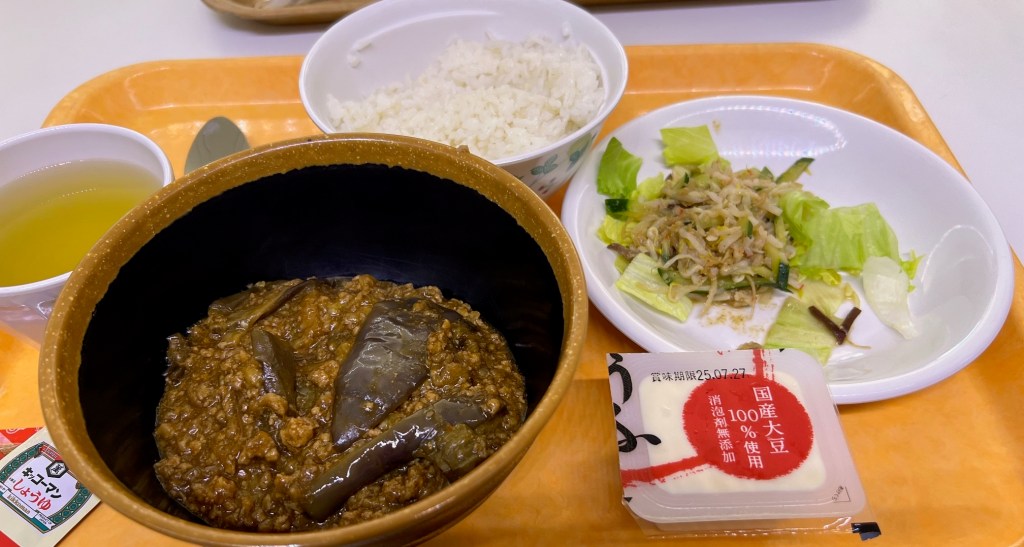
    At lunch, I had a set meal of mapo eggplant at the company cafeteria, dining with some colleagues. When I took a photo of my lunch, they looked at me curiously and asked, “Do you always take pictures like that?”
    I smiled and replied, “Yeah, I send them to my family or put them in my journal.”

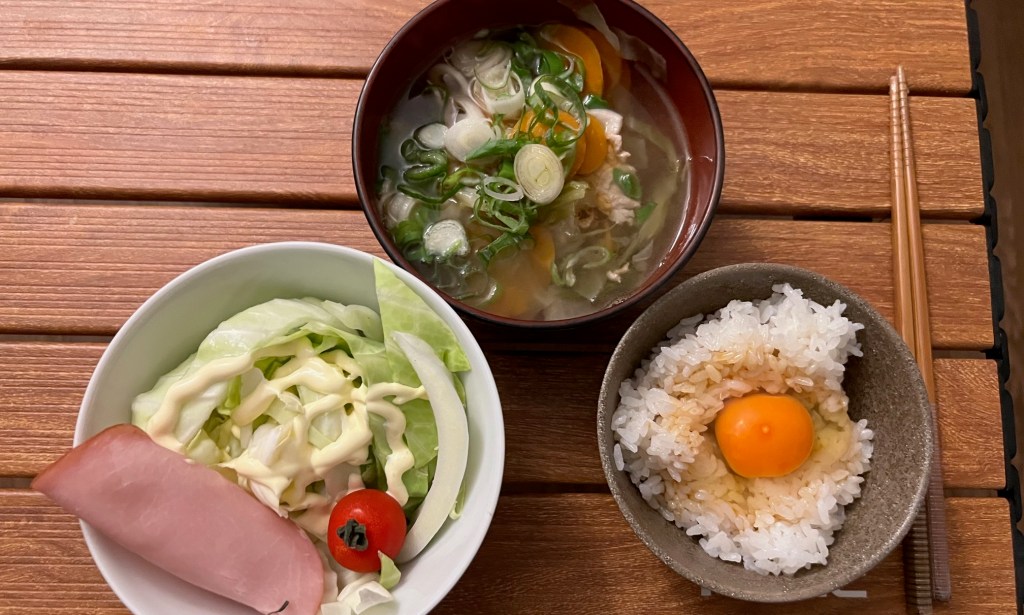
    After another hectic day at work, I came home in the evening and cooked dinner—some cabbage soup I’d made in advance, sautéed spinach, ham, and eggs, and a simple bowl of rice with raw egg.

    Just recently, the Wimbledon final wrapped up, where Jannik Sinner defeated Carlos Alcaraz to claim his first Wimbledon title. The day before yesterday, I woke up at 3 a.m. just to watch Sinner serving for the championship, completely thrilled. But today, I found myself watching a YouTube video of the Kanto singles tournament for players over 80.

    Even at that age, they’re out there playing official singles matches. Of course, they can’t hit powerful shots like the younger players. But I found myself applauding these 80-year-old competitors even more enthusiastically than I did during the Wimbledon final.

    It reminded me that I, too, can continue on with my tennis journey. It was a clear reaffirmation that tennis is truly a lifelong sport.

    As the extraordinary becomes ordinary, there may be fewer things left for me to write about in my journal.
    But I still want to keep capturing the small moments of wonder, joy, and surprise I find in everyday life.

  • Sunday, July 13th.
    It’s scorching hot just stepping outside during the day. The sun is blinding.
    I hopped on my bike to go shopping, only to find it had soaked up the sun’s heat under its black cover—so hot it could fry an egg. After riding, I took off my helmet and my head was drenched in sweat.

    I recently bought a bigger backpack, so I stuffed my groceries into it and carried them home. Still, once you add drinks and such, it’s heavy—and above all, it’s hot.
    A motorcycle ride is supposed to let you cut through the air with a pleasant breeze, but on a day like today, the wind is lukewarm and anything but refreshing. Waiting at a traffic light, all I could think was, “Come on, give me a break…”

    I squinted under the blazing sun as I walked from the parking lot to my apartment. I must have had quite the grimace on my face.

    The moment I got inside, I switched on the air conditioner and turned on the fan. I wiped my face with a towel and let the fan breeze wash over me—a small moment of bliss.
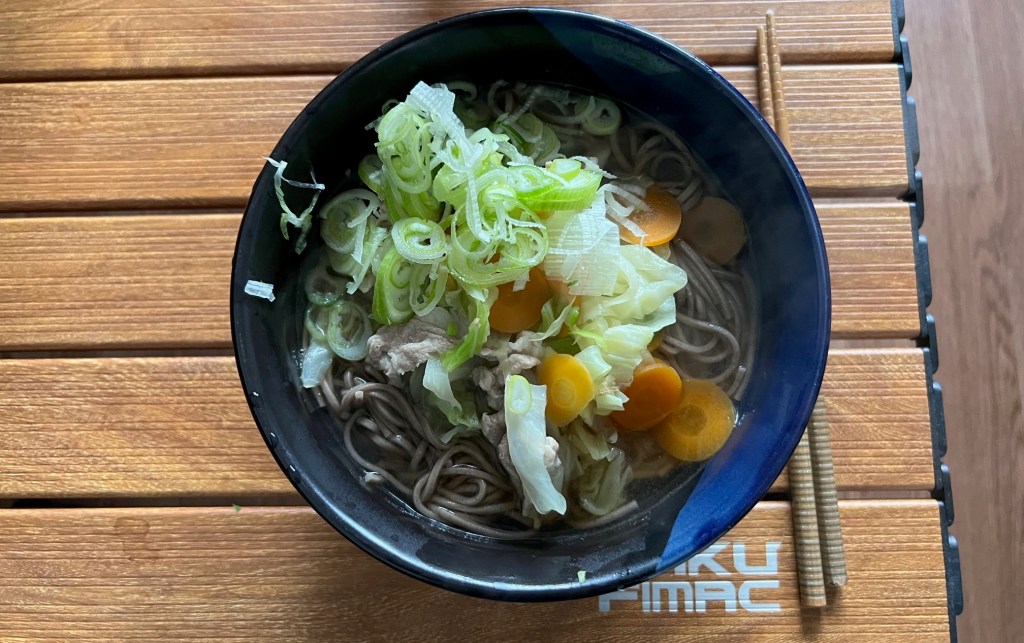
    I had tennis lessons at 2 PM, so I needed to have lunch early. I turned on the kitchen fan, boiled soba noodles on one burner, and simmered pork, carrots, and cabbage on the other. I added bonito stock to the soba sauce for extra flavor, then poured the hot soup over the noodles in a bowl and topped it with chopped green onions.
    Maybe I’m the only one who craves hot soba on a day like this.

    After lunch, feeling cozy and satisfied, I headed out for my tennis lesson.
    Just like yesterday, there were only four students today, so I got to hit plenty of balls—great practice. The coach who’s been in charge of my lessons since July is still relatively new to me. We haven’t had that many rallies yet, but he’s really good. I wonder who he is. Once we’re more familiar, I’d like to ask about his background.

    It was another tough session, and my body’s pretty beat. If I don’t keep my swing relaxed, the fatigue sticks with me. Coaches do this all day, every day—it’s honestly impressive.

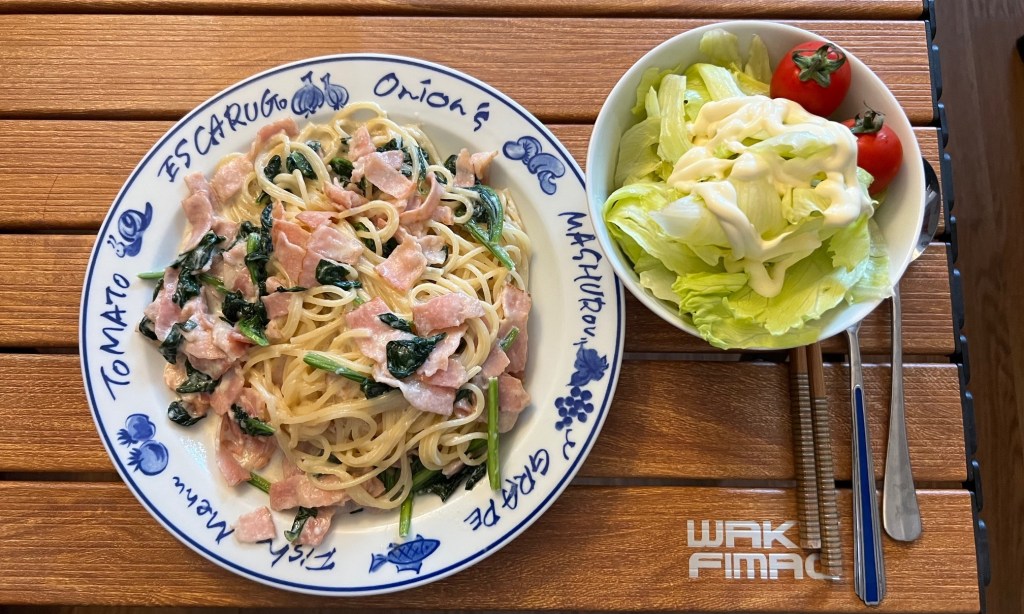
    Back home, it was time to prepare dinner. Tonight was spinach and bacon cream pasta.
    While the pasta boiled, I sautéed the bacon and spinach, added milk and brought it to a gentle boil. A bit of grated cheese and garlic finished off the sauce, then I tossed in the pasta. Adding a little pasta water at the end seems to keep it from getting clumpy. I also made a salad with some lettuce that was on its last legs. It all turned out delicious—a perfect way to wrap up the day. I let out a contented sigh.

    Oh right, today’s the Wimbledon final. Sinner vs. Alcaraz. I’d love to watch it, but it doesn’t start until midnight…
    No way I can pull that off, not with work starting up again tomorrow.
    Still, I’ve got tomorrow’s tasks pretty much sorted in my head. Today’s lesson was intense and left me a bit stressed, so maybe I’ll try a weekday evening lesson next time.

  • Saturday, July 12th. Towering cumulus clouds are rising in the sky.
    In Osaka, the temperature reached a sweltering 36°C—a true midsummer day.
    Ever since I adjusted my medication back to the previous dosage, that foggy feeling in my head has lifted.
    Yesterday, work went smoothly enough. But as quitting time drew near, fatigue started to catch up with me.
    I went home, had dinner, and promptly fell asleep. I didn’t even manage to write in my journal.
    According to my smartwatch, I was already asleep by 9 p.m.
    When I woke up this morning around 6:30, I realized I had slept for nine and a half hours.
    I must have been more tired than I thought.

    This morning, I went to a clinic by Takatsuki Station for my annual health check.
    After drinking barium and having my stomach X-rayed, I felt pretty nauseous.
    But when the doctor went over the results with me, he said everything was generally fine. That was a relief.
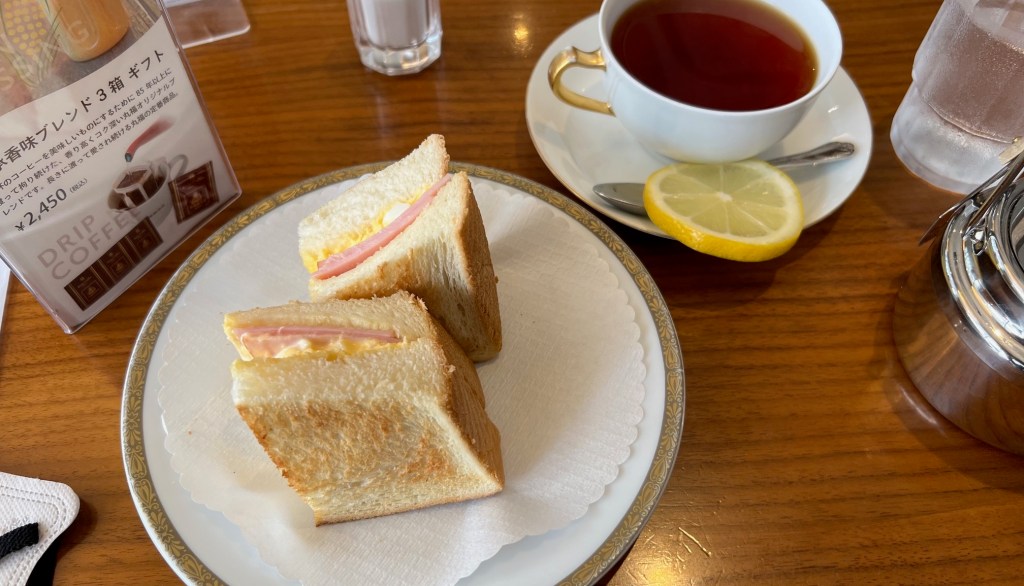
    By then, I was also quite hungry from skipping breakfast, so I used a coupon they gave me and grabbed a sandwich at a café in the same building.

    Back home, I spent some time gazing absently out the window at the cumulus clouds.
    They drifted on the wind, changing shape moment by moment.
    It was a truly summer sky, though the view lost some of its charm because of the scaffolding still set up on the apartment’s exterior for repairs.
    With a slight feeling of confinement, I passed the time quietly in my room.

    Then, breaking the silence, my phone buzzed—a LINE message from my sister.
    She was over at our mother’s house in Naruse.
    It seemed she had taken care of the paperwork to transfer funds from our late father’s frozen bank account into our mother’s name,
    as well as handling the contact needed to change the internet contract out of his name.
    It’s a real help when my sister comes by like this.
    If I had to travel from Osaka to handle everything myself, it would take far too long.
    All that’s left now is probably to go to the Legal Affairs Bureau to take care of the house inheritance.
    Apparently, I can make an appointment online, but I was still feeling sick from the barium today, so I decided to leave that for tomorrow.

    For dinner, I had curry, salad, and a bowl of miso soup.
    Later tonight, I have a tennis lesson booked.
    After a long workweek, the stress has really piled up, so I’m looking forward to working up a good sweat and blowing off some steam.

    Even so, it strikes me how long the days have become.
    It’s already past seven, and yet there’s still a faint light lingering in the sky.
    As I walked past the railroad crossing, I saw a Hankyu train just beginning to turn on its headlights.
    Between the gaps of distant buildings, I could still spot some of those towering summer clouds.

  • Thursday. It’s somewhat cloudy. My head feels a bit hazy—probably due to the increased medication. On my way to work, I suddenly wondered if I had brushed my teeth this morning. When I touched my cheek, I could tell I had shaved. My teeth felt smooth too, so I probably did brush them, but I must have still been half-asleep. I had no memory of doing it.
    It left me feeling uneasy, so I stopped by a convenience store, bought a toothbrush set, and brushed my teeth again in the office washroom.

    The whole day felt like I was surrounded by a fog. I couldn’t really focus. Thankfully, there wasn’t too much work, so I managed somehow. But if this continues tomorrow, it’ll be a problem. It’s been years since I’ve felt like this, so I’ve decided to go back to my previous dosage and see how it goes.
    Sorry, but that’s all for today.

  • July 9th, Wednesday. Sunny.
    Since the rainy season ended early this year, summer will likely be long.
    For breakfast, I fried up some frozen fried rice.
    I was supposed to have a tennis lesson yesterday, but had to work a little overtime, so I missed it.
    I thought about rescheduling it for today, but decided against it—I wanted some time to simply unwind.

    Today, I got through a full day of work, came home, had dinner, and now I’m relaxing.
    It’ll probably still take some time before I truly feel I have room to breathe in life.
    By “room,” I don’t mean financially—I mean space within my own heart.
    Even so, little by little, I feel my rhythm falling into place.

    The friction with my wife, my concerns for my mother, and somewhere inside me, a feeling almost like resignation.
    How will I live from here on?

    There’s no need to overthink it.
    Everything will work out in its own way.
    But I mustn’t neglect my efforts.

    Maybe tomorrow, if I feel like it, I’ll pick up my racket for a bit.
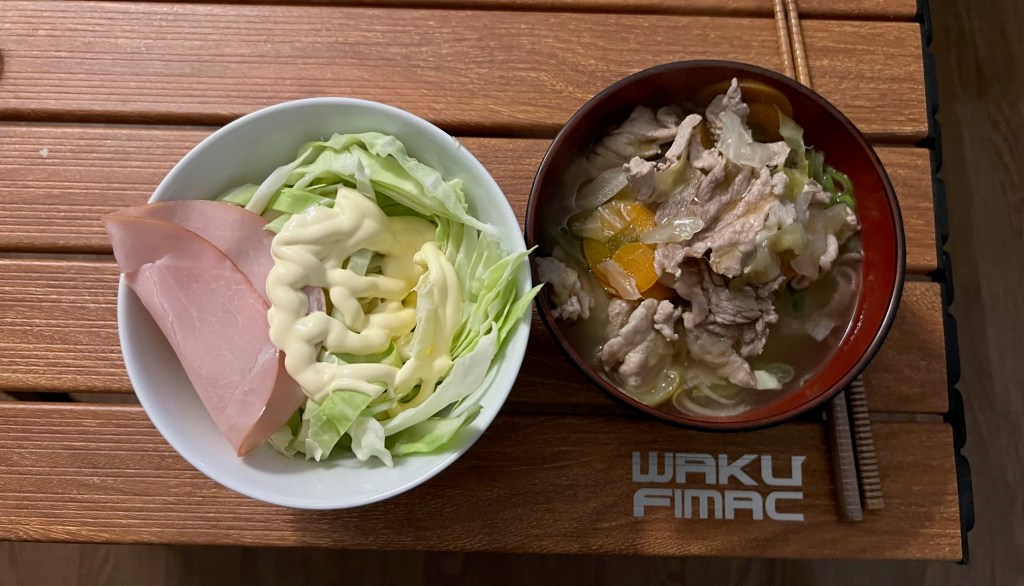
    Tonight’s dinner was rice porridge made with a cabbage soup I’d prepared earlier.
    Lately, cabbage has practically become my staple food.

  • Tuesday, July 8th.
    I still had some bread left over from when I made French toast on Sunday, so for breakfast today, I toasted a slice, topped it with lettuce, ham, and cheese, and enjoyed it. I toasted the bread in a frying pan with some butter. Who needs a toaster when a frying pan does the job so well? It’s surprisingly versatile.

    Today was cloudy, so the heat was more bearable, and the commute wasn’t as tough. The other day I had symptoms close to heatstroke, so I decided to stop wearing a suit to work. Now I go in a Nike cap, T-shirt, light track jacket, and black high-cut Converse sneakers—casual wear. I did feel a bit awkward suddenly changing my style, but most of my colleagues dress similarly. Besides, I change into work overalls at the company anyway, so it was no problem at all. I can keep my work clothes in my locker there, and they even wash them for us. That means fewer loads of laundry at home, which is really convenient. More than anything, it’s so much more comfortable walking outside on these summer days. I wonder why I didn’t start doing this sooner.

    Once work begins, I spend almost the entire day staring at my computer screen, typing out emails or glued to CAD drawings. Even with a lunch break, my concentration inevitably wanes, so I deliberately pause now and then—let out a slow breath, close my eyes, and turn my attention inward. I take a deep breath. Or I have a bit of idle chat with my coworkers. Sometimes, just for a change of pace, I spend a few minutes drafting posts like this one. During today’s lunch break, I put on my earphones and quietly listened to Aoi Teshima singing “The Rose.”

    While I’m in Osaka, I try to message my mother and wife on LINE as often as I can. Lately, I’ve been sending them pictures of what I’ve cooked or eaten that day. The replies are usually simple: “Oh,” or “Looks good.” But I’d still worry if the conversation ever completely dried up. I want to know how things are going back in Tokyo, even if just a little. Of course, it also helps ease the loneliness of living by myself. When we’re face to face, I sometimes get unreasonably irritated, so maybe this bit of distance is just right for now.

    Tonight’s dinner was some cabbage soup I’d made ahead of time, paired with rice and raw egg, plus shredded cabbage. I took a photo of that too, planning to send it to my family. Lately, my wife teases me on LINE, saying, “Don’t you ever get tired of eating that?” Like I’ve written before, little comments like that can linger in my chest more than I’d like.

  • Monday, July 7th.
    Clear skies.
    It’s Tanabata today, but I have no plans to meet my own Orihime.
    She’s probably busy working at the pharmacy in Tokyo, and I’m here in Osaka, having just finished my tenth technical document.

    I wonder when it started—this gradual growing apart.
    Maybe it’s because I wrote about my wife in yesterday’s post that I find myself thinking about it again.
    Whenever we talk, she almost mechanically disagrees with me.
    Her replies always begin with “But…”

    We’ve been together for over 25 years, so I know by now that it’s unconscious on her part.
    When we first met, it didn’t bother me much.
    “I guess she has her own way of seeing things.”
    That’s all I thought back then.

    But as we spent more years together, I began to realize it wasn’t that simple.
    She’s not expressing a different opinion based on her own beliefs.
    Perhaps, by denying me, she’s somehow managing to hold herself together.

    Since realizing that, I can’t talk to her the way I used to.
    It’s still manageable over LINE, but face-to-face conversations have become a little hard.
    Now that we’re living separate lives in Tokyo and Osaka, maybe I should use this time to sort out my feelings.

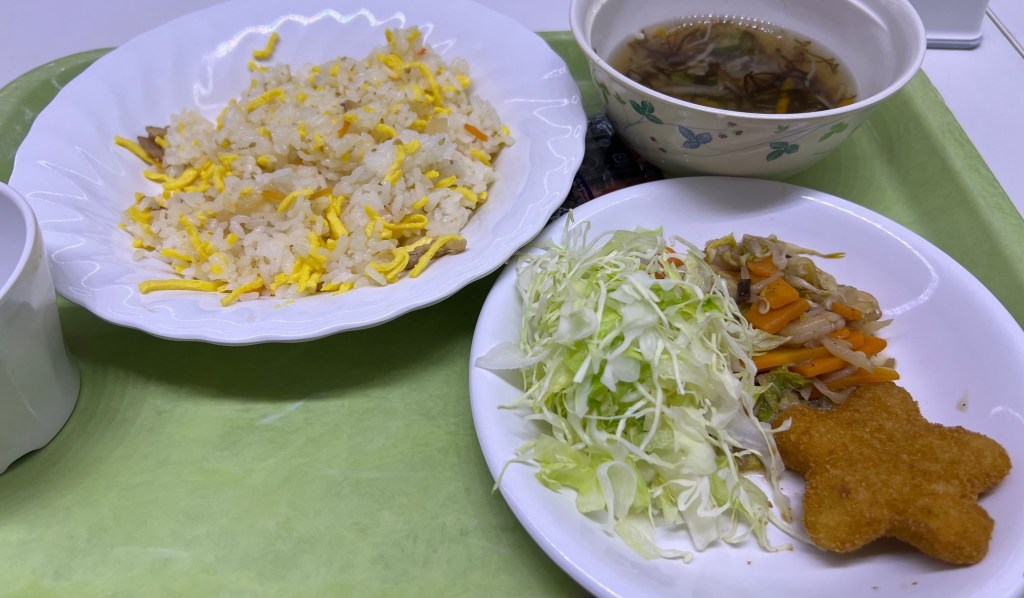
    For lunch, I had chirashi sushi and mozuku seaweed soup at the company cafeteria.
    There was also a star-shaped croquette, in the spirit of Tanabata.
    It’s been a while since I’ve eaten something vinegary.
    For the sake of better nutrition, maybe I’ll start adding dishes like that to our meals at home.

  • Sunday, July 6th.
    This morning, I casually turned on the TV and found a documentary showing the lives of people in a small village centered around a dairy farm. A first-year junior high school girl living there said she loved being surrounded by nature and watching the Zao mountains, whose expressions change every day. She talked about how she wanted to create as many irreplaceable memories of her school life as possible with her many friends, and that since she loved animals, she hoped to become a veterinarian in the future.

    Though you could sense the fragility and delicateness that come with her sensitive age through her expressions, she had firm thoughts of her own and was living earnestly, protected by the adults around her. Dairy farming is hard work, but the surrounding nature of Mount Zao is breathtakingly beautiful, and you could really feel the harmony between people’s lives and nature there. I found it truly beautiful—and, in some way, enviable.

    When I was her age, I didn’t have the luxury of thinking about such things. I didn’t know what I wanted to do, or even what was wrong with me. I was in so much pain, unable to do anything, barely managing to fend off the pressures forced upon me by those around me. Sometimes I wonder if there could have been another way to live, but perhaps that was simply who I was at the time—that was my way of living.

    Now, with a fragile autonomic system, living with a mental disorder, after a long battle with illness, and nearly sixty years old—
    even so, just as that young girl is beginning to walk her own path, I feel now, from the bottom of my heart, that it’s my turn.


    Since I had a tennis lesson scheduled for the afternoon, I planned to keep lunch light. This time, I decided to try making French toast, something I had always wanted to try. It was like the one Dustin Hoffman, playing the father, made in the movie Kramer vs. Kramer.

    I mixed one raw egg, a tablespoon of sugar, and 60ml of milk well. Then I soaked a thick slice of bread in it for about two minutes on each side, letting the egg mixture thoroughly seep in. I put some butter in a frying pan and cooked it just enough to get a slight golden color on both sides.

    Perfect. Delicious. The outside was fragrant and the inside was creamy—exactly like the French toast I often had at hotel breakfasts when I was traveling abroad. When I sent a picture of it to my wife, she replied with a smiling emoji, saying, “Please make that at home for me next time.”

    Lately, we’ve had some arguments over my mother, and we’ve kept a bit of distance. But since we can still talk over LINE, in this particular matter, I actually felt a little relieved that I was living alone for work. People often say we can’t change, but throughout my life—especially with my illness—I’ve always been updating myself and changing. I don’t think my wife has quite kept up with the changes inside me. I wonder if, like the Kramers, we’ll be able to make up again someday. It probably depends on whether we can both notice and care about each other’s changes. As for my own Meryl Streep at home—she hasn’t yet come around to fully accepting me.


    Today’s lesson started at 2:00. The tennis school I attend in Tokyo is quite different from the one in Osaka. In Tokyo, they use sand-filled artificial grass courts (called Omni courts), the same kind used for professional matches, and they use pressurized balls. The Omni courts also have large irregular bounces. The courts in Osaka are carpet courts. Because carpet courts have a faster bounce, they use non-pressurized balls to reduce the ball’s speed—regular players couldn’t handle the usual pressurized balls on such a fast surface. The carpet courts also don’t have irregular bounces, making it easier to read the ball’s trajectory.

    Switching between these two completely different environments every two weeks is quite tough. Well, if I treat the first lesson after switching as just a warm-up, by the second time, I usually get used to it.

    Today’s lesson used the slower non-pressurized balls. Yesterday, the first day back on carpet, was a disaster, but I figured I’d be more adjusted today. Since the ball comes to the hitting point more slowly than on the Omni courts, I switched to a heavier racket with a clearer feel at impact, and that worked great—I could hit the ball really cleanly. In the past, I would’ve just rejected the change outright, but maybe now I’ve developed more adaptability to different environments. Being able to adapt and even enjoy it—that’s a huge step forward.

    I got in another satisfying workout today. And little by little, I’m also starting to make some friends I can chat with there, which means a lot.


    After a shower, I came home and started preparing dinner. Tonight, I decided on carbonara. I boiled the pasta, sautéed some bacon, and made a sauce with eggs and parmesan cheese. Up to that point, it was simple—but finishing it off in the frying pan was the tricky part. If the pan is too hot, the eggs scramble. So, I turned off the heat and used only the residual warmth of the pasta to mix it.

    In the past, my cheese-and-egg sauce was too cold, so the dish cooled down too quickly and I couldn’t enjoy it warm. This time, I pre-warmed the bowl with boiling water before adding the sauce, and then added a bit of hot pasta water when mixing it all together, to keep it smooth.

    When I tried it, it was nicely warm. Yes! Finally, on my third try, I managed to get it right. I allowed myself a little moment of self-praise. Now I’d have something new to chat about with my wife and family over LINE.

  • Saturday, July 5th.

    This morning I slept in until around 8 o’clock. The sky was beautifully clear. For breakfast, I had mildly seasoned fried rice. I’d decided to take it easy today.

    I turned on the TV and watched a recording of the 2025 Roland Garros French Open final—Carlos Alcaraz versus Jannik Sinner. Since it was an epic five-set battle lasting over five hours, I didn’t watch every point with rapt attention. Instead, I let the cheers and commentary play in the background while I did some laundry and tidying up, occasionally glancing at the screen. Still, whenever there was a spectacular shot, I couldn’t help but let out a cry of delight. There are moments in today’s cutting-edge tennis that truly take your breath away. The power and consistency of the shots have clearly evolved. Players now use the court in an even more three-dimensional way, unleashing heavy, high-bouncing topspins, or taking the ball early and driving it flat from above shoulder height. Mixed in are rising shots and delicate drop shots—it’s remarkable to watch.

    Once I finished tidying up, I made soba using kakiage tempura I’d bought at the supermarket. As always, I added pork, cabbage, green onions, and some carrots. The broth was a light soba sauce with bonito stock. This is the flavor that always puts me most at ease.

    I spent the afternoon in a calm, absentminded sort of way. I sat back in my reclining chair and closed my eyes. With the air conditioner running, the windows were shut, so I couldn’t hear much from outside. Still, the faint, steady sound of the Hankyu Line trains passing by reached me. I took a deep breath. It felt good. I was truly relaxed.

    My wife called my cell phone. Because my father’s bank account had been frozen, some of his contracts that were set up for automatic withdrawal couldn’t be paid, and bills had arrived at the house. My mother was surprised by the unexpected notices, so I explained the situation to my wife and asked her to handle it. She called me twice more after that. It seems she’s taking care of various procedures for changing the account names. I feel sorry for relying on her so much, and living separately in Tokyo and Osaka is inconvenient at times like this. I wonder how much we can sort out during my next trip back home. Still, I’m grateful my wife is handling things.

    At 8 tonight, I have a tennis lesson booked. I haven’t been moving my body much lately, so I plan to sweat just enough to count as rehab. For dinner, I’ll keep dinner light with some tomato soup and bacon and eggs.

    I imagine that match at Roland Garros was probably watched by the very generation that had me so captivated—Roger Federer and Rafael Nadal. I wonder how they felt seeing it. I remember watching their Wimbledon finals, or the Australian Open, hugging my knees in front of the TV, hands sweating as I stared at the screen. Those days feel so nostalgic now. If it were Nadal in his prime on clay, I still believe he’d be stronger than Alcaraz or Sinner today.

    I want to keep believing that.