
Last Friday fell in the middle of the May holidays. I had originally planned to take a day off, but work had piled up beyond control, so I decided to go in. Even so, I was to return to Tokyo that same day, so I wrapped things up at three in the afternoon and boarded the Shinkansen.
My sister had told me that my mother, who lives in Tokyo with my wife, had tripped over a sofa at home and fractured her ribs. She had already been treated at the hospital and was wearing a corset, but the pain was so severe that she could barely move. Still, I had lost count of how many times she had fallen and broken something. She was eighty-six now, yet whenever something caught her attention, she would start moving in a hurried trot. No matter how many times I warned her, she never listened. Perhaps because of that accumulation, what rose in me was not so much concern as a weary sense of here we go again.
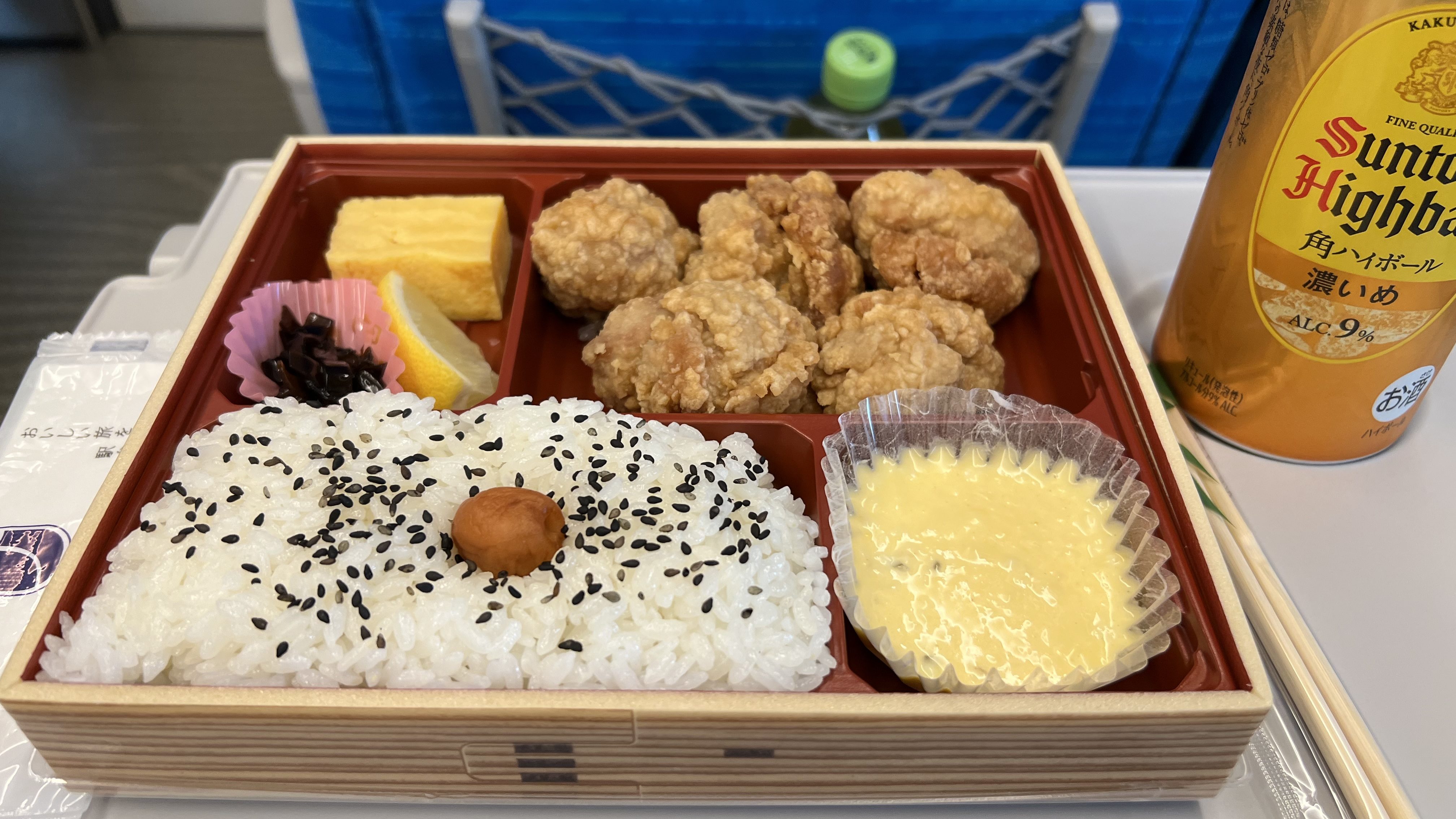
In the fading light of the train, I did what I always do—I took a picture of my meal and sent it to her on LINE, adding, “I bought a fried chicken bento on the train today.”
“It looks delicious, eating a bento on the train,” she replied, just as she always did.
Looking at that message on the screen, I found myself sighing for no clear reason.
I may have mentioned this before, but my mother had a strong faith. As a child, I was taught little beyond what Buddhism was, what compassion meant. When I brought my troubles to her, she would dismiss them, saying it was because my prayers were insufficient. Perhaps because of that, I was left with a certain habit: whenever I found myself at a crossroads, I would hesitate somewhere along the way, unable to decide before pausing. It is a tendency that followed me into adulthood, and one that has cost me more than I can easily measure. What a parent and child ought to be does not apply to every family. Whenever I think of my mother, I sometimes feel a crushing emotion that defies explanation.
I arrived home late that night. We exchanged only a few words before I took a shower and retreated to my room, sinking deep into a chair. In the dim light, I took a single sip of Scotch, but my body gave way all at once, and I turned off the light and lay down on the bed.
I fell into a deep sleep, but before dawn I had the same kind of dream again. Someone was ordering me to issue an urgent change to a project. I frantically struck the keyboard, but the monitor warped before my eyes. The longer I stared, the smaller the screen seemed to become. I had to send the email quickly, but panic overtook me. The distress lingered until I woke with a start in the dark room, the curtains still drawn. When I looked at the clock, it was already past eight in the morning.
I went downstairs for breakfast. The living-dining room, about eighteen tatami mats in size and facing south, held two black reclining chairs in front of a forty-two-inch television. Behind them stood a table, and further east, the kitchen. The shutters and curtains on the south-facing windows were still closed.
My mother lay in one of the recliners, its back tilted far down, a blanket draped over her. Her eyes were closed, her face contorted in pain. As I prepared breakfast, I spoke to her. She said the pain from her broken ribs was unbearable. If she stayed still, it did not hurt, but she needed to go to the bathroom every ten minutes, and so she had no choice but to stand. She didn’t know what to do. She began to sob. The frequent trips to the bathroom had apparently started that morning. Even as we spoke, she repeatedly dragged herself to the toilet, bent over, clearly in distress.
I opened the shutters and curtains. She explained that the day before yesterday, when she had tried to open them, she had tripped over the recliner behind her and fallen. Around that time, my wife came down to the kitchen and joined us. We watched her for a while. She went back and forth to the bathroom, sometimes staggering. It might have been cystitis.
I put her in the car and drove to the hospital. It was fortunate that it was the last day of consultations before the long holiday. The sky was clear, the fresh greenery dazzling, but my mood did not lift. I carefully helped her out of the car, supporting her by the waist as we made our way to the entrance. She walked slowly with a cane. She looked so frail that the nurses who greeted us watched with concern and spoke to us.
After the examination, she was prescribed medication for cystitis in addition to her usual prescriptions. On the way out, her legs wavered and she caught herself on a chair in the waiting area.
“Are you all right?” a nurse asked hurriedly.
“Thank you,” I said.
We picked up the medication at the pharmacy and somehow made it back home. As we sat and talked, she seemed to regain some composure. What struck me as strange, however, was that during the hour and a half from leaving for the hospital to returning home, she had not once said she needed to use the bathroom.
Still, her condition had stabilized, and I was able to breathe again. I took out my phone and contacted a friend. I had been invited to a barbecue at a friend’s house in Enoshima that afternoon, but I explained the situation and canceled.
My wife prepared lunch. The cabbage had begun to spoil, so she cut away the usable parts and added them to ramen. There was also a pizza left in the refrigerator from when my sister had visited the previous week, so we had that as well. The three of us sat together and talked at length for the first time in two months. Only a short while earlier, my mother had been in visible distress, but now she even smiled. She worried that I had lost weight and tried to make me eat everything. I told her, as I always had, that food is best enjoyed in moderation, but no matter how many times I explained it, she never seemed to understand.
To prevent her from falling again, my wife suggested moving one of the heavy reclining chairs from the living room to the basement to create more space. The gas water heater had been malfunctioning, so we called a technician to repair it. I checked the output of the newly installed solar panels using an app. My wife handed me documents from the Tokyo Metropolitan Government and asked me to complete the procedure for a subsidy, which I did on my phone.
That morning, she had barely been able to walk even with a cane, yet by the afternoon she was striding about and had begun vacuuming the room. I could not find the words to make sense of it. Before I knew it, evening had come.
My mother began to complain that she could not understand anything difficult—that she could do nothing without someone to look after the gas or electricity. She said that when she was alone in the house while I was in Osaka, she spent her days in tears. I took out my phone again and called a high school friend, apologizing that I would not be able to attend the reunion planned for that day.
My father passed away last May, and my mother now lives with my wife. At his funeral, many people from their religious community were in attendance. Even at an advanced age, many of my parents’ friends remained energetically engaged in their faith. And yet, there seemed to be something misaligned between my mother’s words and her actions.
My wife works during the weekdays, so it may be only natural that my mother feels lonely. I am reminded again that this places a burden on her, and I feel sorry for that. Still, the fact remains that the mother who once imposed her faith on me so forcefully now does not seem to rely on it at all.
No matter how I try to understand why, I cannot arrive at an answer that is enough to quiet the unease in my chest.

 Canon's Diary
Leave a reply to Secret Diary of A Country Vicar’s Wife Cancel reply