Action without thought is empty; thought without action is blind – Goethe
While living with schizophrenia, I move between Tokyo and Osaka. Through this journal, I hope to quietly share moments from my daily life—and memories from the journey I’ve taken with my illness.
Wednesday, May 14th. Around 3 a.m. last night, I realized I’d fallen asleep in the recliner and moved to my bed. This morning, I felt a bit sluggish. I had forgotten to take my nightly medication, so I quickly swallowed it with a full glass of water. The coldness going down my throat helped wake me up just a little.
The temperature was high from early in the morning, and the sky was clear and bright. From downstairs, I heard the sound of footsteps crunching over the gravel in the garden. My mother had opened the living room window and stepped outside, probably to check on the medaka fish tank. She and my father used to take care of the medaka together when he was alive. It was my father who started keeping them, but over time, my mother became quite used to caring for them as well.
After brushing my teeth, I had my usual two slices of toast and began handling the paperwork following my father’s passing. We needed to change the names on the water and electricity accounts. We also discussed within the family whose name should go on the house deed. There were many things we didn’t fully understand, and we wanted to make the transition in a way that everyone could agree upon, so I decided to consult a judicial scrivener who was my classmate in high school. We’re scheduled to meet tomorrow night.
I had been worried about my mother, but for now, she seems to be managing to hold herself together. As she folded my father’s clothes, one by one, I saw both strength and loneliness in the curve of her back.
I canceled the contract for the smartwatch my father used. The home phone and internet require a copy of the family register to confirm his death before we can change the account holder, so that will have to wait until next week. As for switching my mother’s employee pension to a survivor’s pension, we’ve scheduled an appointment at the Machida Station Pension Consultation Center on June 27th.
The funeral expenses needed to be paid in cash, so I withdrew money from the bank. Tomorrow, one of my father’s acquaintances wishes to pay their respects, so I plan to take my mother to the funeral home where my father is resting.
There was a notice in the city bulletin about the “12th Special Consolation Payment for the Bereaved Families of the War Dead,” and I will need to handle the paperwork for that as well.
I had a little free time, so I checked my work emails. There was nothing particularly urgent. The new project I’m supposed to handle is being temporarily managed by my supervisor. I couldn’t grasp the details just from the email, but I’ll make sure to get a proper handover once I return to work.
The day passed quickly. As evening approached, my west-facing room became filled with harsh sunlight, so I closed the curtains halfway, and the room grew dim. The outside air had cooled enough that I could probably turn off the air conditioner.
When I turned around, I saw the guitar on the stand my father had passed on to me. It felt, somehow, as if he were still watching over me.
I woke up this morning and brushed my teeth. Expecting another busy day ahead, I had two slices of toast for breakfast to keep my energy up. There are still many items left on the list my father titled “Things to Do When Hidero Dies”, but taking them one by one, they aren’t all that difficult. Leaving behind a list like this—it’s just so typical of him.
The sky is completely clear today, not a cloud in sight. I can hear the sound of the garbage truck collecting household waste. I’ll need to reschedule the health checkup in Osaka that was originally set for the 15th. I also contacted the tennis school to cancel today’s lesson.
Yesterday, my sister returned home, and my wife left for work this morning, so from today, I have to take care of things on my own to some extent. A pendant I had ordered online arrived yesterday—it’s meant to hold ashes. I gave it to my mother so she could keep a part of my father with her.
While sorting through my father’s document shelf, I came across a sealed envelope labeled “Will.” Inside, it read:
“All of Hidero’s assets are to be inherited by his wife, Ayako Kazane. After her death, the assets are to be equally divided between their son, Masato Kazane, and their daughter, Ayaka Shindo. This will has been prepared first and foremost with Ayako Kazane’s financial security in mind, and secondly, in the hope of avoiding any unnecessary disputes between Masato Kazane and Ayaka Shindo.”
This was something my father had already told us while he was alive, and both my sister and I were aware of it. “I know,” I said aloud, almost unconsciously, in response.
I also found a CD-R with a recording of my father playing the guitar. He had told us, “Play this at my funeral.” I was truly glad we found it before the ceremony.
After a light lunch, I went out in the afternoon to print a photo to be used at the funeral and bought a frame for it. When I returned home, I sat down at my computer and resumed the process of transferring names on official documents. Meanwhile, my mother sat quietly, listening to the CD of my father playing the guitar, with his photo placed gently in front of her.
Yesterday, I must have fallen asleep in bed without even realizing it. I hadn’t taken a shower. On the table sits a half-finished glass of whisky, its fizz gone flat. My eyes seem swollen. It’s now 6:30 in the morning. I take a small sip from the glass on the table. Once again, tears begin to well up.
Today at 11 a.m., there’s a meeting scheduled to discuss the arrangements for my father’s funeral. It seems my sister will be attending with me. I also need to notify my company about taking bereavement leave. The balcony outside the window looks slightly wet—apparently it rained last night. The sky is overcast.
Before the meeting with the funeral home, I started handling some of the recommended administrative procedures: switching the NHK license out of my father’s name, canceling his mobile phone contract, changing the names on the landline and internet services. Notifications also need to be made regarding water and electricity bills. My sister is taking care of the claim process for his cancer insurance payout.
Many of these services are difficult to reach by phone, often routed through automated systems, but once things are underway, most of the tasks should be completed within a week. I’ve heard that switching my father’s pension to a survivor’s pension for my mother will be especially time-consuming.
During the meeting with the funeral home, we decided not to hold a formal funeral. Instead, we will arrange a farewell gathering in the room where my father is currently being kept, and then proceed directly to the crematorium. A member of the Soka Gakkai women’s division came to visit and offered her condolences to my mother. She also kindly explained the procedures for the farewell service.
It seems that a few volunteers from the youth division will lead the sutra chanting as dōshi (chant leaders) during the gathering. Several members who had close ties with my father also plan to attend the service.
In the evening, I completed the cancellation of my father’s mobile phone. I’ve set it up so that any incoming calls to his number will redirect to my phone.
Time continues to rush by, leaving little space for reflection. That’s all I can write for today.
On the morning of May 11th, after finishing breakfast, I did some laundry under the clear skies. While I was at it, the floor mat I had ordered arrived. With all the furniture finally in place, the floor mat was the last piece. So, I moved the TV stand, the table, and the cupboard out of the room to lay it down. The bed, however, was far too heavy to move alone, and getting the mat under it was a real struggle. The early summer warmth quickly soaked my T-shirt in sweat. After much effort, I finally managed to slide the mat under the bed and started the next task.
Just then, my phone rang. It was my mother. “The hospital just called,” she said calmly. “Your father doesn’t seem well. He’s not responding to voices. They said it would be best if the family gathered—can you come to Tokyo now?” My mind froze for a moment, then shifted abruptly. “Of course. I’ll be there as soon as I can,” I replied, then hung up.
I hurriedly brought the laundry inside, changed out of my sweaty T-shirt, threw on a jacket, and left the apartment with the furniture still scattered about. I tried to stay calm, but it wasn’t easy. Little things—like a slow walker ahead of me, or the loud clang of a train crossing—set my nerves on edge. I boarded the Nozomi 94 from Kyoto at 13:45. It was scheduled to arrive in Shin-Yokohama at 15:37, so I expected to reach Machida Municipal Hospital around 16:30. I sent a message via LINE to my family, letting them know my ETA, but there was no “read” mark. They were likely too preoccupied to check their phones.
Around the time the Shinkansen approached Hamamatsu, a LINE message came from my wife. Sadly, she wrote, my father was already in cardiopulmonary arrest by the time she and my mother arrived at the hospital. The doctors would wait until my sister arrived before giving the official explanation and death certificate. But because rigor mortis would begin soon, they wouldn’t be able to wait for me.
The roaring sound of the Shinkansen filled the car. Office workers typing on laptops, couples enjoying bento and beer, a young man quietly listening to music with eyes closed, a woman watching streaming videos on her phone—the cabin looked just like any ordinary day. I didn’t know what kind of expression I should wear. I put on my mask, lowered my head, and let my bangs fall over my face.
From Machida, I took a taxi to the hospital and finally saw my father in the mortuary. He looked peaceful, as if smiling in his sleep. A wave of emotion surged through me—powerful and unstoppable.
On the evening of April 30th, after dinner, my father said, “I’m going to the city hospital for a bit.” He had been running a slight fever for a few days, and although we were keeping an eye on it, it seemed his condition was worsening. The signs had been there for some time, but even when my mother suggested calling an ambulance, he repeatedly refused, insisting it wasn’t necessary. As a man of the Showa era (1926–1989), he was used to enduring pain until the very last moment. “I’ll take you to the city hospital,” I replied. It seemed he had already contacted the hospital’s emergency department in advance.
Back in my room, while preparing to leave, I found myself unsure of what to bring, and confusion started to set in. “Calm down,” I whispered to myself.
Just as when we found out about my father’s cancer, I had taken him to the city hospital many times before. We could’ve taken a taxi, but worried about the return trip, I often ended up driving him myself.
My father once showed me a shortcut to the hospital, which went through a narrow, dark residential area. “Don’t cross the narrow road in front of the hospital. Take the main street around,” he would always instruct me, every time we took that route. “I know,” I would reply quietly, then turn left onto the main road and drive up to the hospital.
After checking in at the reception, my father was wheeled into his room. Though the emergency ward was quiet during the Golden Week holiday, we weren’t the only patients there. My mother and I sat in silence in the waiting room, simply waiting for time to pass.
Sitting beside me, she curled her small back and murmured, “I’m worried.” I didn’t respond. I simply closed my eyes in silence.
In that waiting room, my mind wandered through memories with my father.
I recalled a black-and-white photo in an old album, with me still in diapers, standing alone in front of Taro Okamoto’s Tower of the Sun. The Osaka Expo was held in 1970, so I must have been about two and a half years old. I imagine my father drove us all the way from Tokyo to Osaka. Sadly, I have no memory of that trip.
My father often took my sister and me out. I can’t remember exactly where we went, but I do recall sitting in the back seat of his car with my sister. I also remember whining every time, wanting to go home early.
When I was in early elementary school, living with my grandfather, there was a photo taken in the factory on the first floor. I was scowling at the camera with a toy gun in one hand. In another photo, I proudly posed beside planes and cars I had built out of blocks. There was one showing my awkward face just after making my sister cry. In yet another, I wore a Kamen Rider transformation belt — a popular Japanese superhero character —and seemed to be communicating with someone through a toy walkie-talkie.
I remembered how, back in our Meguro days, I used to tie a bath towel around my neck like a cape, wearing the belt and jumping around the house. I suppose I was the kind of child who liked playing alone.
I don’t have many memories of talking with my father. Nor are there many photos of the two of us together. But I’m certain it was he who took all those pictures.
I recall that he was really into photography back then. He loved taking photos but didn’t like being in them.
Even so, the gaze with which he looked at me through the viewfinder quietly resurfaces in my mind now. Perhaps it was a silent expression of love, never put into words.
I wonder where those photos are kept now.
Then, the doctor called us into the treatment room.
My father lay on the bed, looking as though he were asleep. The heart monitor beeped irregularly, and the blood pressure reading was low.
The doctor explained that a stent might be blocked, and that he would be admitted starting tonight. For the time being, he would be monitored in the emergency ward.
As we began the admission process, we were asked to sign two consent forms.
One confirmed our agreement not to pursue life-prolonging measures should his condition suddenly worsen. The other stated that if he were to become delirious or agitated, he might need to be temporarily restrained for safety.
They told us that my father had already been consulted and had agreed.
The doctor’s explanation felt cold, but I understood in my head that these were necessary, practical decisions in a medical setting.
Whether my mother understood the full meaning or not, she quietly signed the papers as the doctor instructed.
While I accepted it all with reason, I also felt a deep, aching sadness stir inside me— and I noticed my hand clutching my bag had stiffened just a little.
On April 29, I had plans for a barbecue at a friend’s house near Kugenuma Beach. After taking the Odakyu Line and getting off at the station, the scent of the Enoshima sea greeted me. Though the sea wasn’t visible from the narrow residential streets, the atmosphere of a seaside town was palpable: people heading to the beach with surfboards attached to their bicycles, women holding down their straw hats against the breeze, and families walking with inflatable rings in hand. The blue sky of May stretched endlessly above.
My friend’s house is situated along the estuary flowing into the Enoshima sea. The spacious living room, with its open design, leads seamlessly to a terrace connected to the garden. In one corner of the lawn, a barbecue grill was set up. This time, six friends of similar age gathered. Though nearing retirement, each was enjoying a leisurely life, and our conversations flowed effortlessly—from health and family matters to politics, economics, and business. A mixed-breed dog, part Chihuahua and Toy Poodle, resided in the house. When I reached out, it approached, wagging its short tail briskly.
It’s only recently that I’ve come to enjoy such peaceful moments. Perhaps it’s a feeling of having finally relaxed. Until now, my life as a working adult felt like a survival competition, always on edge, constantly wary of my surroundings. My values have shifted; I’ve become more attuned to society. The notion that I was someone special, raised in an underprivileged environment, has faded. I’ve learned to forgive my occasional laziness. In the past, I was perpetually tense.
◆The Battlefield Named Entrance Exam Study
I failed my university entrance exams in my third year of high school and began a year as a rōnin (a student preparing for re-examination). Attending a preparatory school, my days were consumed by study—a routine that, in hindsight, was extreme. I’d wake up, eat a slice of toast, ride my motorcycle from home to Yoyogi, park on the sidewalk beside the prep school, and attend classes. During lunch, I’d have a regular-sized beef bowl at Yoshinoya. Afternoons were filled with more study. Upon returning home, I’d eat dinner prepared by my mother, watch my favorite TV show for 30 minutes (Dragon Ball was popular then), and then seclude myself in my room to review the day’s lessons and prepare for the next. I’d usually go to bed past 1 a.m. This cycle repeated daily, mechanically, without much thought. Monthly mock exams at the prep school allowed me to gauge my progress. I had discarded all emotions, suppressing myself entirely. I was accustomed to this suppression, driven by the belief that if I didn’t give my all now, when would I?
I appreciated mathematics for its lack of emotional interference and singular answers. As I progressed, patterns in the problems became evident. By memorizing these patterns, I managed. Physics was similar. Though I struggled during my active student days, recognizing patterns made applying them smoother. For these two science subjects, I adopted a strategy of pattern memorization rather than theoretical understanding. I meticulously maintained my notebooks, using rulers to keep them neat. However, I struggled with Japanese language comprehension, unable to grasp the author’s feelings or read between the lines. While social studies had many memorization elements I excelled at, I couldn’t internalize the sentiments of historical figures or societal rules, making it challenging. English, being a straightforward memorization subject, saw my grades improve proportionally to my study time. Consequently, I chose to pursue a science-oriented university.
◆A Fractured Heart, Yet I Walked On
Science—what kind of jobs does that entail? I had no mental space to ponder such questions. By this time, my heart was likely already broken. I had become someone who couldn’t understand others’ feelings. I spent a lot of time alone, which, in hindsight, meant I experienced less stress from interpersonal relationships. The monster within me remained dormant. In January 1986, the tragic news of the Challenger space shuttle disaster, where seven astronauts lost their lives, was broadcasted. Seeing that, I thought, perhaps becoming a rocket launch engineer, dealing with mechanical and physical aspects, would be suitable. But now, I realize that wasn’t my true desire. I wasn’t particularly interested in rocket development; I merely attached an ideal future image, influenced by a shocking event, based on my current academic trends and how I wanted others to perceive me. It was a foolish delusion, a kind of self-hypnosis. A fragility of heart born from youth.
I almost entirely cut off interactions with friends. I believed that conversing with others would introduce distractions, hindering my studies. That year was solely focused on improving my academic abilities. I compiled my monthly mock exam results into graphs on graph paper to track progress over time. A peculiar pattern emerged: months of poor performance alternated with months of significant improvement. I couldn’t understand why. While English grades improved consistently, physics and mathematics displayed this alternating trend from April to December. In April, I targeted universities like Meiji, Chuo, and Aoyama Gakuin. I excluded Waseda and Keio due to the increased number of exam subjects. With only a year, I believed adding more subjects would spread my time too thin. The mock exam results just before the actual exams were poor. Analyzing the trends, I anticipated better performance in the next exam. Thus, I chose Chuo University, which had a convenient schedule and was close to my first choice. For subsequent exams, I alternated between universities I had low and high desires to attend, adjusting the schedule accordingly. In the two days before the actual exams, I reviewed all the notes accumulated over the year, organizing the question patterns in my mind.
◆The Actual University Entrance Exams
I still recall the sensations of the exam day. I remember Chuo University’s acceptance rate being over ten times. Wearing a black student uniform with a large jumper over it, I entered the exam hall and took my seat corresponding to my number. The winter auditorium was filled with crisp, clear air. Looking around at the others, I thought, only one in ten here will pass. Swallowing dryly, I reminded myself that, being not particularly smart, I had to study ten times harder than others. I had endured a year of hardship for this day.
I was too scared to check the acceptance results in person, so I opted to have them mailed. Receiving the envelope from the university, I secluded myself in my room and, with trembling hands, opened it. Upon finding my exam number among the documents, I couldn’t help but jump on my bed and shout with joy. Even my parents, who had assumed it was hopeless, were surprised and overjoyed. Subsequent exam results mirrored the trends from the mock exams. Regardless of the university’s difficulty, the pattern persisted: passing Chuo University first, failing Aoyama Gakuin next, then passing Kanagawa University. I achieved my first-choice admission to Chuo University. I remember my uncle Michio saying, “Alright, your life is secured now.” For the first time in my life, I felt, “I’ve won.”
However, in retrospect, it was a perilous gamble—suppressing myself to study like a machine. I poured everything from my immature heart into it. I had considered whether I could endure another year if I failed after this year as a rōnin, but instinctively knew I couldn’t. My heart was already at its limit. The thought of not passing sends chills down my spine. If I hadn’t passed then, perhaps…
This is the continuation of my reflections on my university entrance exam experience.
Through this exam, I may have taken my first step from a passive life to one of proactive action. The day I received the news of my acceptance, my heart leapt with joy. But by the next day, I had already calmed down. I felt a deep sense of relief, as if all the tension in my body had suddenly loosened, and I spent the next few days sleeping heavily.
In the two months before enrollment, I found myself thinking about what kind of university life I wanted to lead. The fact that I had passed the exam became a major source of confidence for me—a person who had always lived quietly, belittling himself in the corner of the classroom.
Perhaps now I could live with my head held high. Perhaps I was equal to everyone else.
I believe it was during this time that I began to feel that way.
However, it still took me a long time to truly accept myself. Just because I had passed the entrance exam didn’t mean that anything fundamental about me had changed—and later, I would come to realize this painfully.
As for my recollections of university life, I will share those another time.
◆Now, sitting on a bench and looking up at the sky
I left the barbecue gathering around 3 p.m. and boarded the Odakyu Line bound for Machida Station. I had dinner plans with another tennis group later in the evening. Since it was still early—well before our 6:30 p.m. meeting—I decided to stroll around the streets of Machida for a while.
I browsed through some vintage clothing at a second-hand store, and stopped by a shoe shop looking for a pair of black high-top Converse. But as I grew tired from walking, I sat down on a bench along Chuo Street and started writing this post.
It was a sunny afternoon with a pleasant breeze.
Stylish young people dressed up, student club groups, parents and children walking hand in hand, staff promoting phone contracts, the sound of car engines, and a city council member giving a street speech—
The usual everyday scenes.
And yet, for some reason, today they felt special.
Unchanging memories of the past remain only in the hearts of those who lived them.
How we choose to interpret them—that is entirely up to us.
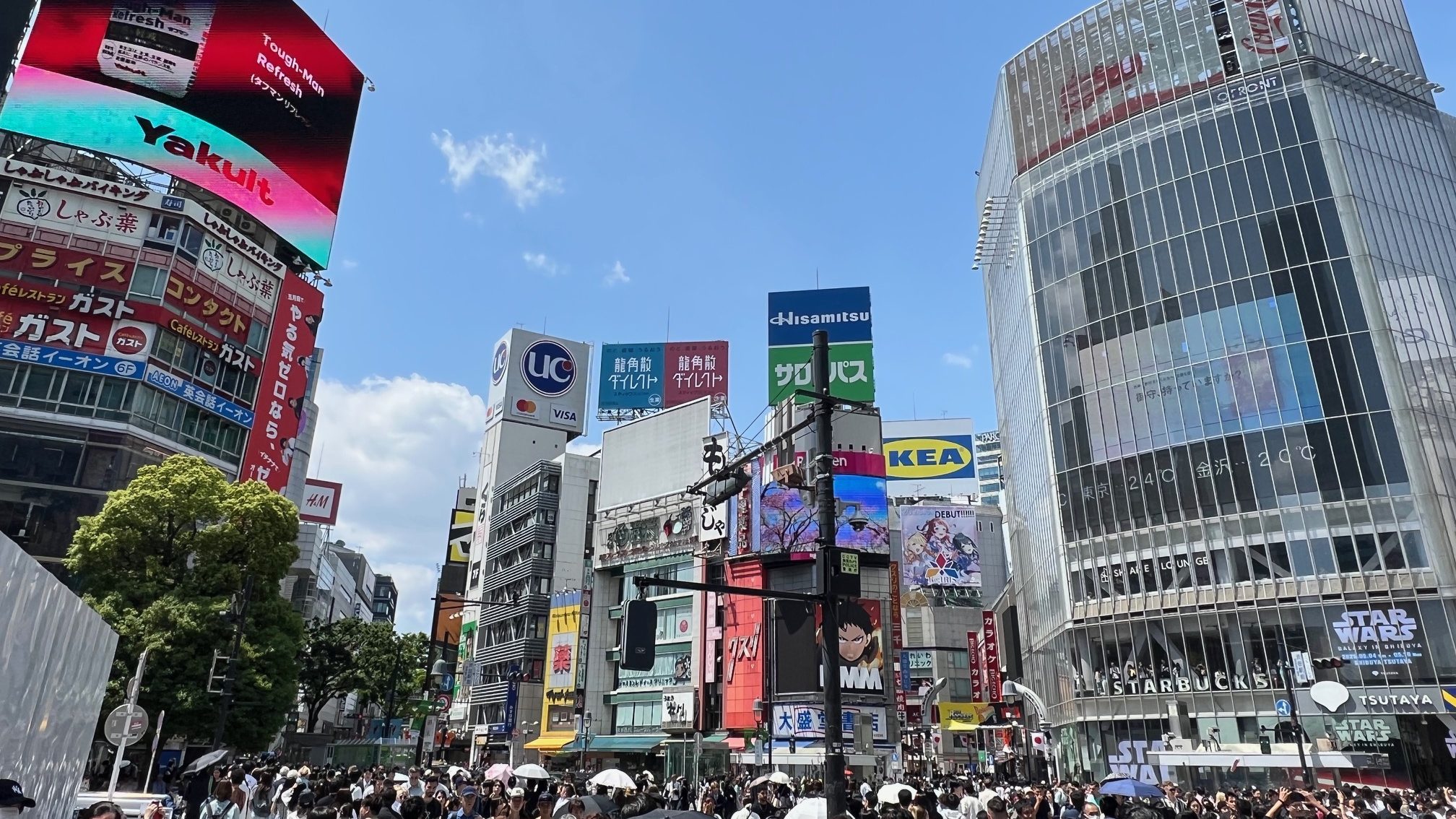
May 5th. I visited Shibuya for a lunch gathering with my old friends from Tokyo Metropolitan Hiroo High School. Around midday, the station was bustling with young people and foreign tourists. Luckily, the weather was clear—important, as I had planned to walk to my alma mater southeast of the station afterward. Towering buildings under a flawless sky, massive LED screens flashing advertisements and lights, and lines of people waiting to snap photos in front of Hachiko. Shibuya isn’t a “completed” city. Construction continues everywhere. It’s constantly evolving. From the Yamanote Line platform, the view is more of a construction site than anything else—unchanged for years. It seems Shibuya’s final form is to remain ever-changing.
We were to meet at the Moai Statue at 1 p.m.—once, alongside Hachiko, one of Shibuya’s iconic meeting spots. Now it’s been moved to a quieter corner near Route 246, and I felt a pang of nostalgia. There were six of us—friends close enough that we no longer needed small talk. I arrived a little early, leaned against the railing, and sipped coffee from a flask. Memories of high school came flooding back.
◆ Lost in the Name of Freedom
What would I do with my life? After my dream of becoming a painter had died, I had no clue. I barely spoke to my parents. I didn’t follow the news. I simply lacked information. I chose Hiroo High only because my father had attended it. Perhaps because of its location, it had a very polished and liberal atmosphere. There were no strict rules, no uniforms. Some students came wearing black leather jackets and carrying electric guitars—no one objected. That freedom became part of the school’s vibe.
It wasn’t an academically intense school, so there was no real pressure. And by high school, even the rebellious types mellowed out. Everyone enjoyed cultural activities in their own way—sports, art, music. But perhaps that freedom made me anxious. I didn’t know what to do with it. I had few friends, largely due to my own social awkwardness.
◆ Conversations with an Engine
Due to its urban location, the schoolyard was small—barely half a soccer field. It was shared among various sports teams. I stayed in the soccer club, but it felt more like punishment than passion. It wasn’t that I disliked my teammates. I simply couldn’t break into the circle. I feared being seen as “that weird guy.”
Around that time, I began commuting on a 50cc gear-shifting moped. The road from Komazawa University Station to Shibuya—Route 246—was packed with aggressive drivers during the morning rush. I weaved through cars, rode recklessly. Perhaps I was trying to shake off my self-loathing. The motorcycle became something sacred. When I twisted the throttle, it accelerated. When I hit the brakes, it stopped. When I turned the handlebars, it responded. I couldn’t talk to my classmates, but I could talk to my bike.
With the exception of a few close friends, I bonded more with that engine than with people. It soothed my loneliness.
◆ Reflections of Inferiority
I remember once saying, “Bikes are alive,” and watching classmates recoil in awkward silence. That was also when I started hanging out at arcades. I didn’t know who I was or what I wanted. I drifted through each day.
I probably spent a lot of time comparing myself to the cool, popular students—the entertainers who fired up the crowd at the school festival rock band, or the tall, handsome volleyball captain. I didn’t crave recognition per se, but I’d gotten into the bad habit of comparing myself to others.
◆ A Voice I Want to Believe, a Feeling I Want to Reject
University entrance exams loomed large, but I didn’t think about them much back then—honestly, I’d already given up. I figured I could try again after a year off. My mother wanted me to go to Soka University, but by then, I was openly resisting religious activities. We argued constantly, and it felt like my parents had given up on me.
I didn’t want to rely on them anymore. I wanted to stand on my own. But I still had no idea how. I just understood that I needed to get into the best university I could manage.
Unsurprisingly, I failed all my entrance exams that year. But I didn’t feel crushed. It was like, “This was always the plan.” I’ll share more about my gap year some other time.
◆ The Road to My Alma Mater
After the reunion lunch, we all headed southeast. The same path I took to school every day back then. Just a little ways from the center of Shibuya, the city gives way to quiet residential neighborhoods. The old arcade had become a Chinese restaurant. The candy shop where I used to buy ice cream was now a barbershop. Still, the familiar school route remained, and I walked it again with old friends.
Hikawa Shrine, which we passed along the way, felt like stepping into a mountain forest—an oasis of lush green in the heart of Tokyo. We chatted freely, carefree. When I shared how the freedom of those days had scared me, my friends admitted they’d felt the same, more or less.
I’m grateful for these friends—people who’ve stayed in my life without any ulterior motives, untainted. In ever-changing Shibuya, an unchanging friendship quietly gave me a push forward. That’s what kind of day it was.
On April 26, I drove down the expressway and arrived in Osaka. I stopped by a real estate agency near Takatsuki Station to pick up the keys to my new apartment. With the help of my GPS, I rode my motorbike to my new home near Tonda Station. I had already signed a monthly parking contract for my bike. The shopping street that stretches from Hankyu Tonda Station to JR Settsu-Tonda is packed with small shops — supermarkets, drugstores, izakayas, restaurants, gyms, and even a takoyaki stand. Everything necessary for daily life seems to be there. I could constantly hear the sound of Hankyu trains passing through.
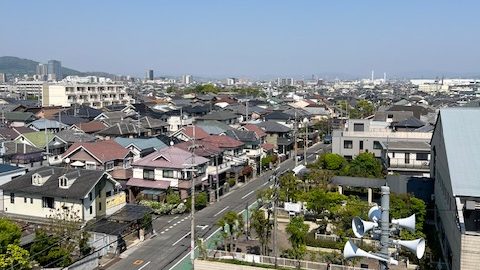
My new apartment is on the sixth floor. I unlocked the door, stretched a bit in the empty room, and took a deep breath. Through the east-facing window, I could see the sunlit tiled rooftops of Tonda Town. Below, there’s a pond called Kodera-ike, alongside the Takatsuki Municipal Library. The surface of the water glistened and sometimes rippled widely. Though invisible to the eye, I sensed the presence of ducks or other wildlife. A feeling of “let’s begin again” welled up inside me. I was grateful to feel this calm. The inner monsters—anxiety, loneliness, unspeakable unease—no longer haunted me. In the past, I had to release myself through soccer, motorbiking, or tennis just to maintain emotional stability. Over many years, I’ve finally reached this peaceful state.
◆ The Cage of Prayer and the Voice Within
I must have been in upper elementary school when I began to feel a strong discomfort toward the religion my mother practiced and taught. Until then, I believed that all children, like me, chanted sutras at home, recited prayers, attended gatherings, and shared personal experiences. But I realized that wasn’t the case—others were far more free. They said “no” when they meant it, spoke their minds, expressed themselves—even argued. I tried to mimic them to some extent, but something always felt off. I once asked my mother why other kids didn’t chant, and she replied curtly, “That’s them. We’re us. They don’t matter.”
While I was taught compassion and the importance of prayer, I felt my individuality and personality were being erased. Crushed by inexpressible anguish, I finally told her: “I don’t want to do this anymore. No one else is doing it, and it only brings me pain. This religion has been suppressing my feelings for so long. I want to tear up the sutra book and burn it.” Her eyes changed. “You can’t do that,” she said. “If you do, nothing but misfortune awaits you. If you tear it, your body will be ripped apart. If you burn it, you will be engulfed in flames and die. The reason your heart hurts is because you lack prayer.”
◆ The Sinfulness of Humanity and the Role of Religion
Today, I think I can understand the teachings of Soka Gakkai. The idea is that each of us harbors Buddha within, and chanting the daimoku is a way to resonate with one’s soul. Even in times of hardship, by chanting and stoking the flame of life, one gains inner strength.
Still, I believe that humans are inherently sinful. There are no such things as Buddha-like people. From the moment we are born, we cry and cause disruption. We eat the lives of animals and plants. We wage war. We destroy nature and build concrete cities. We are deeply selfish beings. We’ve even driven the Earth to the brink with greenhouse gases and global warming. Have you seen the footage of a whale, burdened by barnacles, seemingly pleading with humans for help? To me, the barnacles look like humanity, and the whale like the Earth itself. When I see aerial footage of skyscrapers in big cities, I feel a chill — as if the Earth is silently crying out to be freed. But humans cannot stop their selfish ways. We live with the burden of sin.
◆ The Day I Opened My Heart’s Cage
And yet, we have reason. When we do wrong, we feel guilt. Religion can help cleanse that suffering, strengthen our reason, and teach us to be grateful for those around us. Soka Gakkai is one such example. By chanting the daimoku, one resonates with the Buddha within, releasing inner pain and purifying the soul. I now understand its strength — not relying on a transcendent force, but focusing on self-powered enlightenment. It is, in essence, a powerful and admirable belief system.
But to the child I once was, the compassion and prayers I was taught felt like a curse. I was told that the world is governed by love and justice, but there are emotions in human nature that such ideals cannot explain. Having repressed myself from birth, I became distorted. A monster began to inhabit my heart, trapped within the walls of compassion and prayer — and eventually, I could no longer contain it. I had no choice but to walk away from religion. Letting go of its framework was no easy task. It took countless years to rebuild my identity and cast out the monster. But once I let go, I could finally breathe. I could speak with my own voice and see my life in my own light. I never rejected faith itself—I simply chose a freer path. That, for me, was healing.
◆ A Prayer of Gratitude Held in My Hands
As I unpacked the boxes brought into my apartment, I bundled up the cardboard and took the garbage out. Today, the single bed I had ordered from Tokyo was delivered. Slowly, my new life in Osaka is taking shape. Amid the mountain of boxes, I ate a store-bought lunch. I’ve recently begun putting my hands together in gratitude before meals. Curiously, my mother never taught me this. In my family, we were never taught to fold our hands before eating, nor were we taught the proper customs for Obon or visiting graves. Having stepped away from religion, I still remember the sutras but know little of basic Buddhist customs. When I married my wife, I remember how surprised she was.
Even so, I’ve decided I want to learn this habit — folding my hands before meals to express gratitude to the living beings that gave their lives. Only now do I finally understand how natural and meaningful that is. I think I’m getting better at it lately — what do you think?
On the morning of April 25, a little after 9 a.m., the movers arrived and began carrying out my belongings. Since I didn’t have much and everything was already packed, the two movers loaded everything onto the truck quickly and efficiently. Once they left the house, I promptly began preparing to head to Osaka on my motorcycle.
My father had seen my recent post and declared, “Back when you were in junior high, I wasn’t playing golf—I was just busy.” Oh really? Well, excuse me. I do understand that he was busy. So perhaps it was when I was in elementary school that he played golf? Memory is a vague thing. But what does it matter? Just to be clear, I have no intention of blaming my parents now. That would be utterly pointless. What matters to me isn’t how my father lived his life, but how I felt about it—and it’s that feeling I want to express here.
I left the house just before 10 a.m. The sky was cloudy. Once on the Tomei Expressway, I could feel the chill in the air. Even with a sweatshirt layered on, it wasn’t enough, so I put on the top half of my rain suit to keep warm. Being the day before Golden Week, the roads weren’t too crowded. Though overcast, occasional bursts of brightness appeared as I cruised along. Once outside of Tokyo, everything was green. The Shin-Tomei Expressway, carved through mountains, offered a view of three lanes ahead, and just a glance to the side revealed a dazzling sea of fresh green foliage. The flowing scenery lifted my spirits. Around Gotemba, I caught sight of Mt. Fuji on my right—hazy from smog, but still an imposing presence.
As I rode, my father’s words echoed in my mind, drawing me back to old memories. Back then, I couldn’t express my feelings in words, so I think I needed another outlet. For me, drawing was probably a form of self-expression. Though soccer meant collisions with teammates, frequent injuries, and often unpleasant experiences, focusing solely on the ball, stealing it, and kicking it away was a kind of emotional release for me. I just needed something to immerse myself in. From high school on, motorcycles became another form of self-expression. Letting myself ride with the wind, tilting my head and shifting my hips as I leaned the bike into turns, always keeping my eyes fixed firmly beyond the corner—motorcycling, to me, possessed a kind of artistic grace that cars could never replicate. It felt like a dance.
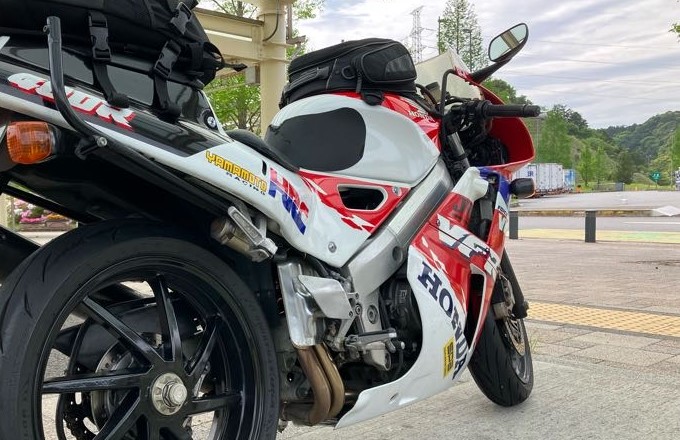
Leaving Naruse behind, today’s destination was Toyoda Town in Aichi Prefecture—a ride of about 284 kilometers. My 1993 VFR400R, with its black wheels and Pro-Arm suspension in OKI racing livery, roared along with a satisfying sound. I took frequent breaks, stopping at almost every service area to refuel and stretch. Along the way, I passed a group of three riders on Honda Rebels several times—we ended up at the same hotel, laughing and exchanging a few words when we realized it. But once in my room, fatigue hit me like a wave, and I fell asleep before I could even enjoy the outdoor bath.
The next morning, while having breakfast at the hotel, a boys’ soccer team in yellow uniforms entered the hall. Two young men who looked like coaches were leading them. The group chatted boisterously. “I want to eat this meatball!” “Coach, can we sit anywhere?” “That’s not garlic, it’s a fava bean. Look closely!” “Good thing the earthquake didn’t hit yesterday. The prediction was off!”
Each kid said whatever came to mind, participating in the group dynamic. And I thought: Even if I were a grade schooler again and part of this soccer team, I probably wouldn’t be able to blend in. I doubt I’d be talking freely like that. I could easily imagine myself quietly sitting alone in a corner. I’m over 50 now and have learned the social niceties expected at work, but I still feel that same discomfort when it comes to joining groups. Despite all my life experience, my core self hasn’t changed.
Susan Cain, born in New York, wrote in her book Quiet: The Power of Introverts in a World That Can’t Stop Talking that in many countries, sociable and outgoing personalities are seen as the ideal. But that’s not natural for everyone, and we shouldn’t force ourselves to emulate extroverts. She highlighted the strengths of introverts: deep thinking, strong concentration, and creativity. “You don’t need to pretend to be extroverted. Being quiet is not a flaw—being quiet is a strength,” she said.
Yes, in the end, I’m just not the type to enjoy lively crowds. I’m much more suited to solitary creative work, like art. Michio dedicated his life to painting. My carpenter uncle, in his spare time, carved a stunning wooden Hannya mask as a hobby. Father—you too, instead of talking, devoted yourself to the guitar. The Kazanekas are an artistic family. This isn’t about upbringing or parental education. This is simply how I was born.
On Saturday, the second day of my trip, the sun was already shining in the morning, and the temperature was high—I had to choose my clothes carefully. After checking out and heading to the bike parking area, I saw that the Rebel group had already departed. I left the hotel, stopped by a convenience store, filled my thermos with hot coffee, and headed toward the entrance to the Shin-Tomei Expressway. At this pace, I should arrive in Osaka by around noon today.
On Wednesday, a fine rain had been falling over Tokyo since morning. The sky was covered with gray clouds. When the wind turned east, tiny raindrops hit the window in front of my desk. Amid the drizzle, a lone crow flew past. Its wings were slightly spread, but it didn’t flap them—perhaps it was simply riding the wind. Its face seemed to be either gazing intently at the ground or turning away from the falling rain. Mixed in with the sound of rain was the distant roar of a jet, though the aircraft itself was hidden behind the clouds.
I was working remotely from my room in Tokyo. I’d heard that the kickoff of a new project originally scheduled before Golden Week might be delayed. Using the information I had, I reviewed the project details and compiled them into a management sheet. The room was still a bit messy with PC cables, accessories, and tennis gear, so I tidied up a little. It’s a 7.5-tatami-mat room, but it feels cramped due to the semi-double mattress I brought from my new house in Yamanashi, along with a large wood-grain desk for remote work topped with a computer monitor. The desk faces a westward window, and there are large windows on the west and south sides.
When I turned around, I saw an old classical guitar sitting there. Peering inside through the sound hole, I found the following inscription in brush-ink:
“Made for Mr. Hideo Kazane — 1964, Noboru Nakayama.”
Hideo Kazane was my father. Searching the name Noboru Nakayama online, I learned that he was a craftsman who supported the Nakasaka workshop and later established his own workshop in Saitama Prefecture in the late 1960s. I received this 60-year-old guitar from my father a few years ago.
My father, Hideo, was always late coming home from work and barely spoke even when he was home. On his days off, he often went golfing. But whenever he was at home, without fail, he played that guitar. As a child, I spent more time listening to the sound of the guitar than hearing my father’s voice. He would always play the same piece—“Romance,” the hauntingly beautiful melody often associated with the film Forbidden Games. Because he was always strumming that guitar, relatives jokingly referred to him as “Buzz-Buzz Uncle.” I have almost no memory of actually speaking with him.
When I entered junior high, I joined the soccer club. My junior high school was located about 400 meters south of my elementary school, right next to Komazawa Olympic Park. It was Meguro Ward’s Dairo Junior High School. It was a sensitive and turbulent time in adolescence, and there were many rough students—some smoked, others even drank before coming to school. I shrank back in fear, kept to myself, and wasn’t particularly noticeable, though I don’t think I was excessively bullied either. It was around the time Gundam plastic models were popular.
I believe it was around this time that I began feeling a tightness in my chest every day. I didn’t understand why it hurt so much back then, but now I think it was because I was suppressing my sense of self too much. Soccer club was terrible. Although I was used to handling the ball, I had no concept of teamwork, so my teammates often gave me disapproving looks. During practice, their treatment of me was harsh. They would deliberately kick at my legs. Sometimes I would fall hard and suffer serious injuries. Yet strangely, I never felt angry. I would pretend to be calm, saying, “I’m fine,” even while bleeding.
I think my emotions were also being suppressed by what my mother had taught me: a spirit of compassion. A devout woman, she always told me to forgive everything others did, never to blame them, and to pray when something happened. So I would convince myself, “These guys are just pitiful,” and leave it at that. Looking back, it doesn’t make much sense. I was probably angering people because I couldn’t understand teamwork. I had no grasp of others’ feelings. In hindsight, it’s clear I was completely in the wrong. But back then, I couldn’t understand that. I was pushed, knocked over many times. I was often grabbed by the collar and got into scuffles. I consulted my mother, but she scolded me for not praying enough and simply told me to apologize and say sorry. But prayer alone cannot help one survive in society. Unable to deal with it in any way and unable to express my anger, I think I accumulated something like poison within me.
Even so, my body, which had been trained through soccer since elementary school, suddenly grew larger and stronger around my second year of junior high. I gained enough strength to push back when getting into scuffles, and gradually, the delinquents who had been bothering me disappeared. Soccer was probably my only means of self-expression. Instead of using words to express my feelings, I kicked the ball. Rather than being a striker charging toward the opponent’s goal, I felt more at home as a defender, swiftly stealing the ball from the opposition.
I couldn’t concentrate in class, and my grades dropped significantly, so my parents hurriedly enrolled me in a cram school. Classes started at 9 PM, but for some reason, I enjoyed them. Probably taught by college students working part-time, the instructors had a humorous and memorable way of speaking that kept me engaged. Thanks to that, my grades began to recover around the end of my second year.
I have no memory of speaking with my father during junior high. I tried hard to recall, but aside from the sound of “Romance,” I remembered nothing at all. Perhaps many families were like that back then. Since inheriting this guitar, I’ve been practicing a bit, though I can still only play simple chords. Yet somehow, I’ve found I can play the melody of “Romance” to some extent, even though no one ever taught me how.