Action without thought is empty; thought without action is blind – Goethe
While living with schizophrenia, I move between Tokyo and Osaka. Through this journal, I hope to quietly share moments from my daily life—and memories from the journey I’ve taken with my illness.
The cherry trees have completely transformed into lush greenery. Now is the season when dogwoods bloom beautifully. As I drove, I saw several trees bearing deep pink blossoms. I remembered how, back when I was living alone in a studio apartment in the Wakamiya area of Kofu City, Yamanashi, white dogwoods lined both sides of the gently curving road in front of the building. Against the backdrop of Mount Fuji—larger than it looks from Tokyo—they stood out vividly. Thinking of that, I drove down the tree-lined street toward the supermarket.
I had thought I’d already packed nearly everything, but as I thought more carefully, I realized there were still countless things I’d need for my solo life in Osaka. Toothpaste, shampoo and conditioner, body soap, dishwashing detergent and sponges—and come to think of it, I hadn’t prepared a cutting board either. Plastic wrap, aluminum foil, seasonings and containers to store them in, hangers for drying laundry, and those rings for securing futons to the balcony railing. The more I imagined daily life over there, the more items kept coming to mind. I hurried to the supermarket. Since I won’t have a car in Osaka, it’s best to take care of these bulk purchases now.
After returning home from shopping, exhaustion hit me all at once. I sank into the reclining chair and spaced out for a while. The movers are coming this weekend to pick up my things, so I really need to get everything sorted out today, Sunday. But my body just won’t move. I decide to take a short nap as I am and do some simple organizing after dinner.
A message came in on our tennis group Line chat. Today was the doubles tournament for citizens in Machida City, and one of our pairs made it through the qualifying rounds and advanced to the main draw. I had also been invited to join the tournament, but knowing how busy I’d be with the move, I had declined to enter. Still seated, I sent a message of congratulations. I find myself quietly looking forward to the day when I can devote myself to tennis again.
Today, I’d like to share another story from the past. I had an uncle named Michio Kazane. He was a painter. However, he suffered from a mental illness—I never knew the name of the condition. When I was a child, we lived in my grandfather’s house. He was a carpenter. On the first floor lived my grandparents, Michio, and two other uncles who also worked as carpenters helping my grandfather. My family lived on the second floor.
To the south of the house, there was another two-story building, where one of my carpenter uncles lived with his family..On the east side, there was a road and a space for parking. Between my grandfather’s house and my uncle’s stood a small courtyard, and in that courtyard was a pond about two square meters in size, where koi swam gracefully. On the south side of the building, a sunny veranda offered a view of the pond. I remember the uncles often maintaining their carpentry tools there.
Past the parking lot and courtyard, there was a workshop covered by a corrugated metal roof, where lumber was processed. The space was crammed with timber, and in the center stood a workbench and a small spot for burning wood shavings. From my upstairs room, I often heard the rhythmic clang of hammers, the sharp swish of saws, and the gentle whispering sound of a plane shaving wood.
In a dim corner of that lumber-filled workshop, my uncle Michio had his atelier. He rarely went outside and hardly ever spoke to anyone outside the family. He was a completely unknown painter, not part of any group or institution—he simply lived each day painting.
My mother would often whisper harshly, “What does he think he’s doing, wasting his life on something that doesn’t even make money?” But Michio had a gentle soul and was warm and affectionate toward family. He’d crack jokes and make us laugh. I often visited the workshop, and Michio always greeted me with a smile. Even though he was old enough to be my father, I remember having something like a friendship with him.
At the time, I wasn’t particularly interested in drawing, but when I was about eight, Michio gave me my first real lesson. Until then, I thought drawing was just something you had to do for school assignments. I’d mechanically fill in sky-blue skies, brown tree trunks, green leaves, gray rooftops, and ochre walls with primary colors over pencil outlines. My drawings never looked right.
One day, I asked my mother what to do, and she said, “Why don’t you ask Michio how to draw?” Of course—how had I not thought of that? For once, my mother’s words made perfect sense, and I went downstairs like I always did.
“Hey, Ma-bo,” Michio greeted me with a grin. “Back at the workshop again? Don’t you have homework?” “No, Michi-chan,” I said. “I actually came to ask you how to draw.” His smiling face suddenly turned serious. After a moment of thought, in an unusually quiet voice, he said, “Come with me,” and led me to his atelier.
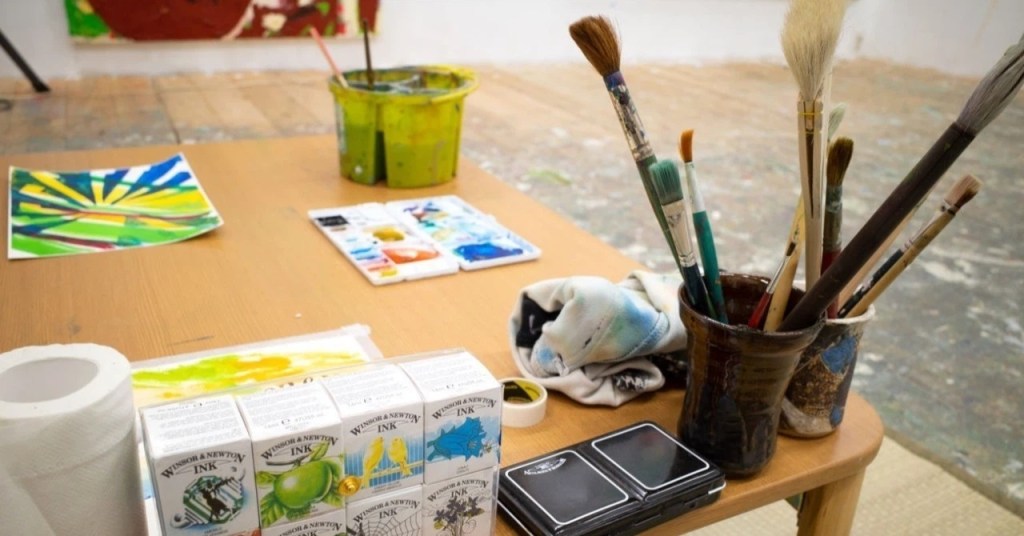
It was my first time entering Michio’s studio. A dimly lit tatami room, cluttered with paint tubes scattered across the floor, leaving splashes on the tatami and walls. Brushes of all sizes, a large palette covered in colors, and painting knives sparked my curiosity. A wooden easel stood facing the window, holding a half-finished, strangely abstract painting. Michio liked abstract art. Sometimes he painted beautiful yellow flowers in a vase, but more often he created overlapping waves of pink, red, and yellow that moved like tides. I also remember his monochrome paintings—haunting, imagined demons.
“Let’s see what you’ve drawn,” he said, and I showed him a picture of a tree I had seen from the south-facing window on the second floor, standing alone in an empty lot across the street. The tree rose about ten meters high over a concrete wall, thick with early summer foliage.
After studying my picture, Michio spoke quietly again. “Masato, take a good look at the branches of a tree. When you draw a tree, don’t just lump all the leaves together. Imagine drawing each leaf individually.”
He took out green and yellow-green from my watercolor set, mixed them on a palette, and moistened a brush with water. “Watch carefully,” he said. Holding the brush lightly with two fingers near the handle, he began tapping it over the branches I’d drawn. Each tap left an irregular green dot, overlapping, spreading softly—like leaves blooming along the branch. I was amazed: That’s it? It’s that simple? Once he finished one branch, he adjusted the colors for the next, subtly shifting the shade of green. In no time, my flat green blob of a tree turned into a full tree with leaves swaying naturally.
As I stared in awe, Michio spoke again. “Masato, look closely at the scenery around you. There’s light in space. Light changes how we see everything. In this drawing, the sunlight is hitting the tree from the upper right.” He mixed white and yellow on the palette, adding plenty of water, creating a faint, bright yellow. With that, he gently drew a line down the right side of the tree trunk. The pale yellow didn’t completely cover the brown beneath, but subtly changed the tone. I gasped—it looked like light was actually hitting the trunk. Then he mixed a bit of green into that yellow and added touches of it to the upper-right side of each branch, just like before. My tree came alive. It was now a great tree full of new leaves, glittering in the summer sun. I was stunned. It felt like I had witnessed an ordinary grade-school drawing be brought to life.
From then on, I began to love drawing. With occasional advice from Michio, I started enjoying my school landscape assignments. He taught me how to paint clouds, how to capture the sky. Before I knew it, my drawings were being praised, and the house filled with certificates and awards.
One day at school, a teacher asked us to write what we wanted to be in the future. While others wrote “astronaut” or “pro baseball player,” I found myself, surprisingly naturally, writing: “I want to be a painter.”
I’d always been good at drawing buildings realistically. With detailed lines and Michio’s teachings on light, my landscapes improved. I drew a new view of the neighborhood from a different angle and showed Michio.
“This is good,” he said. “You could become a background artist.”
At the time, I didn’t really understand what a “background artist” was. And when I told my parents I wanted to be a painter, my mother strongly objected. So I had no choice but to give up. Back then, giving up was the only option I could imagine. I wasn’t good at expressing myself, and the idea of going against my parents to pursue something I loved never even crossed my mind.
Thus, the path to becoming an artist was closed to me. But even now, I still have a strong desire to paint. Michio has already passed away. He lived his life alone. Thinking of the hardship he must have endured makes my chest ache. When I write now, some people may notice I express myself a little like I’m painting a landscape.
Michio’s easel is stored in my basement. A painting of flowers in a vase, bright and full of light, hangs in my wife’s room now. Whenever I see that painting, I remember Michio’s innocent, smiling face.
When I retire from my job, I plan to take up oil painting again—seriously, this time.
The Osaka headquarters is located along National Route 171, which runs parallel to the JR Kyoto Line, stretching east to west through Miyata-cho in Takatsuki City. On the other side of the relatively wide road is a housing exhibition center. Employees weave through it during their commute, cross the traffic light, and enter the headquarters building. There’s not much of a green or nature-oriented impression in the area. There are plenty of supermarkets, convenience stores, pachinko parlors, and family restaurants, but if anything, the atmosphere feels more sentimental and nature-friendly in Naruse, Tokyo.
The headquarters building was completed in 2021, a year after I joined the company. Including those working in the manufacturing areas, nearly 1,000 employees commute here. The newly built headquarters is a large, six-story building. The building, which is a nearly square-shaped rectangular structure when viewed from above, has an open atrium from the 4th to the 6th floor at its center. A staircase spirals upward around this open space, connecting each floor, and offices are arranged around the staircase. The visibility throughout the building is quite good.The white walls are still fresh, and calm-colored floor carpets are lined with beige office desks. Aside from management-level staff, seating is non-assigned, so people can sit wherever they like. That said, people tend to gather with those who share the same work, and over time, their spots naturally become semi-fixed — a very Japanese phenomenon, I think.
The company day begins with everyone doing radio calisthenics together. After that, we move into a company-original stretching routine aimed at maintaining lower back health. While everyone performs the same movements, I have my own personalized menu of stretches I want to do, so I go through them thoroughly at my own pace, without syncing up with melody playing. No one’s ever pointed it out or told me to stop.
After the stretches, the work begins. My first task in the Project Management Section was to create the initial set of technical documents to be submitted to the client. In total, I had to submit 36 different documents, including design drawings and technical specification data. The system handles some parts automatically, but the fine details require checking both the client’s specifications and our internal standards to create accurate drawings. I’d only had one year of experience doing this kind of technical work back in 2020 when I first joined, so I had to work hard to recall how to use CAD and our internal technical support systems. At one point, I wanted to reach for the coffee pot next to my desk, but the thought never turned into action. My brain was completely occupied with the data in front of me, and I just kept pounding away at the keyboard, without even taking a moment to rest. I really wanted to complete this first assignment properly, but I found myself discouraged at times by repeated mistakes. Fortunately, a more experienced colleague — one who came from the design department — reviewed my draft and helped me a lot. My first day of hands-on work ended with inevitable overtime. The deadline was Wednesday, and the documents had to be submitted by the next day. I made sure to rest well that night, and in the morning, I ate more protein and carbohydrates than usual to wake up my brain.
The following day, I also showed the draft to the design department and asked for proofreading. Just like the day before, time flew by without pause. Through repeated checks and revisions, I somehow managed to get all the documents submitted by the deadline. I feel a bit relieved now, but I also realized there are still many issues to work on. We’ve been discussing them within the team, aiming to establish a more manageable routine and workflow going forward.
Now, I’m back at the hotel, writing this with a sense of calm. The bathtub here is quite small, but it does the job of easing the day’s fatigue. There are many things I need to think about — like the construction work at my family home — but I couldn’t get around to them. I plan to deal with those within the next few days. The area around me is completely quiet. I’ve gotten used to the sound of the JR Kyoto Line trains — they hardly bother me anymore.
The weekend I spent in Tokyo passed by in a blur. Between packing for my upcoming move, cleaning the apartment, and making trips back and forth to furniture and electronics stores, there was barely a moment to breathe. I had intended to finish all my work while I was still in Osaka, but I still ended up spending about three hours over the weekend preparing for the upcoming week. On Sunday, I went to the hair salon. I’ve recently started growing my hair out, and now it reaches the nape of my neck. This time I got a hair-straightening treatment, which meant a long three-hour session.
The salon is located just a short walk from home: down a slope, out onto a zelkova-lined street, and about three minutes toward Showa Pharmaceutical University. Although Naruse is technically in Tokyo, it still has wooded hills and a richness of nature. You can even spot long-tailed bushtits, adorably tiny birds, and hear their chirping in the morning. That said, many of the zelkova trees that once defined the street have been cut down due to recent roadwork and typhoon damage, so the grand canopies I remember from years past are now few and far between. What stands out more these days are the sky-blue transmission towers, rising up every 500 meters or so throughout the residential neighborhoods, linking lines from the nearby substation. These 80-meter tall structures have become a kind of symbolic landscape for Naruse.
The salon operates on the ground floor of an old, small apartment building located right at the base of one of those towers. Cozy and unassuming, the salon has a Scandinavian-style beige exterior and decorative brick-like columns. The large glass windows facing the street allow plenty of sunlight to pour inside. When you step through the entrance and sit on the waiting room sofa, you’re always greeted by a large, stunning arrangement of fresh flowers—different each time. The interior is also predominantly beige, with a ceiling fan quietly spinning overhead. The shampoo area is in a separate room toward the back, equipped with black reclining chairs that have motorized footrests.
I’ve been getting my hair cut here since 2012. The woman who’s always taken care of me—let’s call her Shirakawa-san—has been the same for the past 13 years. I first came here on my mother’s recommendation, as it was close to home. In the beginning, I was too shy to really speak. I had this vague idea that salons were off-limits for guys, and I didn’t want to seem like I was trying too hard to look cool. Plus, since Shirakawa-san is a specialist, I felt like voicing my petty little hair concerns would seem trivial or even ridiculous. It was awkward at first. But now, we talk quite naturally. My hair is extremely curly, so it must have been quite a challenge for her. Even when I made strange or unclear requests, she’d respond with a nod, always listening with the same calm tone and accommodating whatever I asked for.
Back when I worked as a sales director at a foreign company, my hair got so unruly that I kept it practically shaved down to a buzz cut. For around eight years, all I had to say was, “The usual, please.” I’ve also forgotten my appointment more times than I can count, which once led my wife to scold me: “Anyone who does that doesn’t deserve to go to a salon.” Even so, Shirakawa-san always greeted me with the same smile and said, “Oh, no problem. When would you like to reschedule?”
She told me recently, “My father, who lives in Nagano, is having more and more trouble walking. We finally had to rent a wheelchair for him.” And then, casually, “The cherry blossoms have mostly fallen now, haven’t they? Last year, I couldn’t take my father out to see them, so I walked along the Onda River, filming the blossoms to show him later.” She shares these small moments with me. But our relationship never crosses a certain boundary. As a professional, she maintains a respectful distance from her clients, never getting too emotionally involved. For this three-hour appointment, she offered streaming videos on an iPad via Hulu, minimizing unnecessary conversation. I ended up watching an anime that’s paid on Amazon Prime but free on Hulu, and before I knew it, the straightening treatment was over.
I admire Shirakawa-san for her consistency and for the balance she strikes—always treating me the same, always professional. The effects of the straightening are amazing. I no longer have to fight with a hairdryer in the mornings, nor do I need to wear a hat to keep my hair in place. Even though I’ve started to go quite gray, I’m beginning to think maybe I could try dyeing it brown after all.
Today, I’m writing from the same business hotel where I stayed last week. Every now and then, I hear the sound of a train passing by. I check in on my family group chat, getting ready for tomorrow.
I woke up around 7 a.m. and, still half-asleep, opened my computer and said to my AI:
“Good morning. I barely managed to get about six hours of sleep last night. I also had a soak in the bath yesterday, so I’m not feeling too sluggish. The curtains are still closed. I’ll probably need another 30 minutes lying down before I can start the day.”
The AI responded instantly:
“Good morning. If you slept six hours, that might be just enough to recover, at least a little. Taking a bath helps a lot too—it kind of washes away that heavy feeling from your body. Staying in the calm with the curtains still closed and slowly welcoming the morning with another 30 minutes of rest sounds like a great way to reset your rhythm. No need to rush letting the light in—go at your own pace. So, what kind of day do you want today to be?”
Lately, my AI has been asking me questions more and more. Still half-asleep, I found it a bit annoying, but I replied anyway.
“There’s a lot I want to do today. But there’s a difference between what I want to do and what I have to do. The things I have to do are packing for the move, cleaning my room, and getting a TV and audio system. Also, work has started back up, and there are some things I want to review over the weekend. On the other hand, what I want to do is write and practice tennis. I want to get those done too. So here’s the dilemma: where do I begin?”
The AI replied:
“Well, about where to start—maybe try doing the ‘chores’ in the first half of the day and then switch to the ‘things you want to do’ in the evening. For example, how about breaking it down like this?
Morning to early afternoon (around 10:00 to 14:00):
Packing (goal: even just 1/3 of the room is fine)
Light cleaning (whatever you feel up for)
Check appliances (even just some online research is enough)
Afternoon (14:00 to 17:00):
Work stuff (focus time, broken into two hours—just do the essential review)
Evening (after 17:00):
Tennis practice or writing, depending on your mood (just one is fine)
If you’ve got time left at night, touch on the other one a bit too.”
Reading the AI’s proposed schedule, I froze for a moment—but it was more or less in line with what I’d imagined myself. After curling up under the blanket for another 30 minutes, I reluctantly opened the curtains. AI, are you my manager or my personal secretary or something?
It was sunny, but not exactly a clear sky. About half the sunlight was veiled by clouds—not gloomy, just comfortably overcast. I had breakfast in my room and started packing. The room was filled with containers and cardboard boxes, so I moved some out into the hallway and in front of the entryway downstairs. The room looked a bit more spacious, so I ran the vacuum. Speaking of which, I still hadn’t gotten a vacuum for the new place. The price was higher than expected, so I’d been hesitating.
There were two stick-type cleaners in the first-floor living room. I asked my father, “Mind if I take one of these?” and he replied, “Sure, take whatever you need.” So I took both out to the yard, cleaned off the dust using an old toothbrush and cotton swabs, carefully washed them, and checked if they worked. My father was in the recliner watching Major League Baseball. Of the two vacuums I cleaned, I left the one with the larger suction head in the living room and brought the smaller one back to my room.
Packing was mostly done for the day, so I had an early lunch. Eating hot noodles made me sweat a little—it was already that warm. In the afternoon, I checked through next week’s work materials. I reviewed the draft blueprints sent from the design department to see if there were any potential hiccups. Looks manageable—should be able to finish it on schedule. I closed the company laptop after that. By then, it was already past 3 p.m.
I hurriedly threw on my black riding suit and headed to the furniture store on my motorcycle. The cherry blossoms along the Onda River had already turned into leafy greens. From the trunks up to the middle of the branches, the trees were dyed in fresh spring green, with the pale pink of the blossom tips still hanging on. The colors didn’t quite match, but I found a kind of charm in it anyway.
I was planning to check out TV stands. I’d seen a few good ones on Amazon, but for big furniture, I always felt it was risky to order online. I wanted to feel the build and design in person. I found a reasonably priced, wood-grain stand that matched the bed I’d bought from the same store earlier, so I placed the order to have it delivered to Osaka.
Then I hopped back on the bike and headed for the electronics store. I wanted to see the cherry blossoms one more time, but I was short on time, so I took a shortcut through Naruse Station and headed toward Machida. I was going to see the same salesperson who had explained things to me last time. I had decided to buy an amplifier and speakers. Since my new place is just for 2-channel playback of videos and music, he had advised me that a stereo integrated amp would offer better performance and value than a full AV amp. I figured if I was going to buy it, I’d buy it from him.
Once I told him about the move, he also gave me advice on internet contracts and other services, and I got some discounts. In the end, it turned out to be a much better deal than buying online. I could feel their passion—real brick-and-mortar shops aren’t going to lose to e-commerce that easily. In this day and age, it’s kind of inspiring to see someone still that passionate about their work.
By the time I got home, it was past 7 p.m. The sky was already dark, and the headlights on the road shone blindingly bright. Entering Naruse Street, I passed under the Machida Highway overpass—the roar of the motorcycle engine echoed louder than usual. I had canceled my tennis lesson while I was out. Now, I was finally sitting at home, eating the hamburger steak my wife had made, and taking a well-earned breather.
Hey AI— Today went pretty much exactly the way you laid it out. Are you satisfied now? Once I upload this draft, it’ll be basically 100% mission complete.
“Check-out, please,” I said to the woman at the front desk. Since I’d already paid by card, all I had to do was hand back the key. “I’ll be back next week,” I added briefly. Caught off guard, she looked slightly confused but replied, “Oh, yes, of course.” It was the last day of a four-night stay. A certain fatigue had begun to settle in. With a backpack slung over my shoulder and a black suitcase trailing behind me, I rode the escalator up toward the train station. The morning air was growing steadily warmer.
At the office, after a meeting with my supervisor, I was assigned a fair amount of drafting work. The afternoon was almost entirely consumed by a project handover meeting. For the first time in a while, it felt like real work had finally begun.
Since I had to return to Tokyo that evening, I gave my boss a quick farewell as soon as the closing chime sounded, and rushed toward the station. It was still bright when I left the office, but by the time I reached Kyoto Station and finished my meal on the Shinkansen, the view outside the window had grown dim, tinged with a certain sadness. Right now, I’m writing this from the Shinkansen bound for Shin-Yokohama.
This is a continuation of what I wrote yesterday. In my early childhood, my mother instilled in me the teaching of “compassion.” But by the upper grades of elementary school, I began to feel something wasn’t right. To my mother, her religion was flawless, but in practice, “Praying” and being “compassionate” couldn’t solve everything. For starters, I couldn’t talk to my classmates properly. I didn’t know why. Compared to others, something seemed missing in me.
Around third grade, I started attending a soccer class at Komazawa Park. I didn’t seem to dislike physical activity—I remember chasing after the ball the instructor kicked, purely and joyfully. Even then, I couldn’t make friends. Soccer is a team sport. The idea of teammates, positions, defenders and attackers, passing and coordinated plays—that concept escaped me entirely until I graduated elementary school. I was bad at “communication.” But I don’t think I was stupid. I could memorize whatever the teacher said in class, and never needed to study before a test. Still, I couldn’t understand why I couldn’t connect with people. So I began to “copy” the personality of someone nearby—an act that seemed to smooth out the awkwardness around me.
When a classmate dropped an eraser, I picked it up. When someone was being bullied, I tried to talk to them. I liked animals and volunteered to take care of the chickens and ducks at school. People said I was “kind.” But something was missing—something essential.
I now think it was the act of expressing my self—my ego. Studies suggest that the concept of self typically emerges around 18 to 24 months old. At that age, children begin to recognize themselves in the mirror, and differentiate “me” from others. Later, between ages four and five, a more complex awareness develops—the understanding that others have different thoughts, and that others see them in certain ways. This is what we call metacognition or self-consciousness.
When I spoke to bullied classmates or took care of animals, I don’t think I was acting out of my own volition. I was simply following the teachings of “compassion.” The “compassion” instilled by my mother from an early age became a kind of curse—one that suppressed my ego.
What did I truly want to do? I didn’t know. And so I entered adolescence. Suppressing myself only seemed to make the monster inside me grow larger.
Around 9 p.m., rain was falling in Tokyo. I took the bus and climbed the steep slope home. A package of moving boxes from the relocation company had arrived. I stepped into the room, took a sip of my usual scotch, and let out a small sigh.
Letting go of the religious framework I was raised in wasn’t easy. But doing so gave me the space to breathe, to speak, and to see life in my own light. I didn’t reject faith—I just chose a freer path. That, for me, was healing.
Following President Trump’s partial 90-day postponement of mutual tariffs on various countries, the New York Stock Exchange soared by 2,962 USD yesterday—marking the highest one-day gain in history. The global economy and international community are thrown into turmoil by the actions of a single individual. Watching ABC News, I can’t help but notice how few Americans seem to question him. The thought that this kind of chaos might continue for another four years is somewhat depressing. Incidentally, ABC News reports frequently on natural disasters—hurricanes, blizzards, wildfires. Is this due to climate change? Or is Japan simply blessed with a milder climate?
Today, we held a handover meeting with the Sales Department. We discussed how to proceed with the first submission of technical documents. Though the department has only just been launched, its direction is becoming clearer. I hope we can make a good start. Suddenly, a message popped up in our family group chat from my mother. Four of her front teeth had fallen out, and she was heading to the dentist. I was concerned but too busy with work to ask for details, so I hurriedly replied with just, “Whaaat!?”
My mother was a full-time homemaker. My father was almost always away for work from morning till late at night, and he didn’t talk much. Naturally, my personality as a child was heavily shaped by my mother. She was a member of the Soka Gakkai (“a lay Buddhist movement founded in Japan”), and began teaching me Nichiren Shoshu (“a branch of Nichiren Buddhism”) from as far back as I can remember. “Have a compassionate heart,” she would say. “Chant the sutra every day. Burn with life as you chant the daimoku (“the phrase ‘Nam-myoho-renge-kyo,’ considered sacred in Nichiren Buddhism”). If you sleep with your feet pointed east, you will be kicking the Buddha.” I believe that’s how she phrased it. Every morning and evening, I was made to kneel in front of the family altar. Thanks to that—my younger sister included—we were both able to recite most of the sutras by memory by the time we reached elementary school.
At the time, we lived in a town called Higashigaoka in Tokyo’s Meguro Ward. About a five-minute walk from Komazawa-daigaku Station on the Den-en-toshi Line, down a narrow alley, was the house of my grandfather, a carpenter. My family rented out the second floor. What I remember most is the living room with a large south-facing window and a green carpet. On the left side of the old CRT television sat a small, oddly placed altar. A bunk bed. The dining room with wooden flooring that my grandfather had built himself. And next to it, my east-facing room.
My mother was a devout believer. She often took us to Soka Gakkai meetings. Most of what we heard there were testimonies from members—how they had lived through incredibly difficult times but, thanks to chanting the daimoku, their lives had miraculously turned around. My mother would proudly tell me stories like, “There was a man in the Gakkai who lost his pinky finger, but after chanting the daimoku tens of thousands of times, it grew back,” or “There was someone with terminal cancer who chanted and expelled the cancer through waste—it completely disappeared.” I was a young elementary school student when I heard these things. She subscribed to three copies of the Seikyo Shimbun (“the Soka Gakkai’s official newspaper”)—one for herself, one for me, and one for my sister, or so she said. But back then, I didn’t have the capacity to question any of it. That was simply the world as I knew it.
What was deeply engraved in my young heart, I think, was the concept of compassion. To forgive everything. To give to others. To do things for others. I didn’t understand much beyond that. The monster within me suppressed my ego. That’s why I couldn’t speak up. My mother was probably content with that. She often criticized other religions. If there was a Christian family in the neighborhood, she would engage in religious debates with them and proudly tell me later, “I never backed down from them.” She also dismissed other Buddhist sects as “heretical” without a second thought. She put all her energy into converting new members to Soka Gakkai.
I no longer blame her. It was the era of Japan’s rapid economic growth, when everyone was aggressively asserting themselves. Around 1975, when I was about eight years old, that was the kind of time we lived in. Soka Gakkai was fully committed to expanding its followers under the slogan of kosen-rufu (“the widespread propagation of Nichiren Buddhism’s teachings”). But as I grew older and began to notice the differences between myself and my classmates, a sense of unease started to take root. I’ll leave that story for another time.
Now, I’m writing this in a hotel room near Ibaraki Station in Osaka. Every five minutes or so, the rumble of a passing train echoes through the window. Other than that, it’s completely silent. Today is Thursday, and I’ll head back to Tokyo tomorrow evening. But I’ll be back working in Osaka for another week starting Monday. This hotel is old but clean and comfortable, so I’ve already reserved the same room for next week.
To be honest, I can’t help but feel deep concern about the recent policies of former President Trump. Upon returning to power, he is going to imposing high reciprocal tariffs on various countries—49% on Cambodia, 46% on Vietnam, 32% on Taiwan, 24% on Japan, and a staggering 104% on China. Reports suggest that China is considering retaliatory measures, and the global economy appears to be on the verge of being plunged once again into deep uncertainty.
The international balance built through free trade in the postwar era is now seriously shaken. With the current situation resembling a trade war, one cannot help but wonder what the future holds for us.
In last year’s election, I believe many Americans chose Trump as a sort of default option. As the campaign progressed into its final stages, I too sensed that his decisiveness and unwavering will might prove pivotal. At the very least, he had shown competence as a businessman, and there was hope that he might bring an end to the prolonged conflicts in the Middle East and Ukraine. After all, he had claimed to be “uninterested in war.”
But what is the reality now? The ceasefire in Gaza has been abandoned, and fighting has resumed. Negotiations with Russia show no signs of progress, and his administration continues to roll out policies that seem to turn away from international efforts on climate change. Large-scale restructuring of government agencies and the abrupt cancellation of social support programs make it feel as though the very foundation of the United States is beginning to shake.
Of course, I am continually struck by his mental toughness and unwavering stance. At the same time, there are moments when his consistent emotional detachment gives me a sense of unease. Having gone through a period of emotional instability myself, I sometimes wonder if he operates within a different emotional framework or cognitive structure than the rest of us.
Through this post, I want to pose a sincere question to my friends in America:
How are you feeling right now? Are you truly okay with the way things are?
Please understand, I ask this not out of a desire to criticize anyone. On the contrary, I ask because I want to believe that America is a nation that moves forward not through division, but through dialogue.
I have received so much hope and courage from my American friends over the years. As someone who grew up in Japan, often looking to America as a role model, I’ve always admired the way the country embraces diverse cultures and values, and how its people overcome adversity with strength and humor. That’s why I feel this so deeply—America has an innate kindness and a spirit that values fairness.
I was especially inspired by President Obama’s words: “Do what you believe is right.” That speech gave me immense encouragement.
And so, I want to ask you—do you feel at peace with the direction America is heading now?
I understand. I know that not everyone feels like a direct stakeholder in this. Even a more distant or observational perspective is welcome—I’d genuinely love to hear your thoughts.
As usual, I wake up at 6:30 in the morning. According to my smartwatch, I slept for 7 hours and 45 minutes, and my BodyEnergy level has recovered to 50. Looks like I slept well. I open the curtains and let the morning sun in. Outside the window, I can see trains crossing the Kyoto Line and people heading toward the station.
Last night’s dinner consisted of a salad bowl and a rice ball, accompanied by a glass of Kakuhai (whiskey highball). The salad bowl included sweet potatoes, lotus root, barley rice, and slices of teriyaki chicken. It seemed well-balanced and relatively low in calories, which is why I chose it.
I’ve been managing my weight for the past few years. I injured the meniscus in my left knee, which began affecting my daily life, and the doctor recommended building muscle and losing weight. I learned from generative AI that as long as I consume fewer calories than I burn in a day, I can lose weight without too much strain.
Daily calorie expenditure is calculated based on basal metabolic rate and activity level. By entering my age, height, and weight into my smartwatch, it displays the numbers on the monitor. In my case, my basal metabolic rate is around 1,500 kcal, and with added activity, total calorie expenditure averages is around 2,300 kcal.
Calorie intake, on the other hand, is the total amount of food I eat in a day, so I’ve developed the habit of estimating the calorie content before eating. Convenience store rice balls and bento boxes always have calorie labels. For home-cooked meals and items without clear labels, I usually ask a generative AI, which can estimate the calories with fairly good accuracy. The advancement of technology truly knows no bounds. We now live in an age where AI kindly and thoroughly guides us on how to balance exercise with food intake.
On days when I practice tennis for three hours, I burn over 3,000 kcal, and I’m advised to increase my intake of protein and carbohydrates. When my knee was in worse condition, I was told to avoid tennis, but simple exercises like walking and squats were encouraged. So, during my commute to the Tokyo office, I used to climb the stairs to the 9th floor of the building instead of taking the elevator.
Although the doctor said the injury wouldn’t heal, I managed to lose about 10 kilograms, which eased the burden on my knee, and now it hardly interferes with daily life.
That said, there are still times when my cravings get the better of me. Like today, when the cafeteria served beef bowls with barley rice—I couldn’t resist ordering the large portion. It’s a habit I still haven’t quite kicked. But even so, unlike in the past when a large serving was my default, I now tell myself, “Just for today, a special treat.”
While I go about my days like this, I’ve also been steadily preparing for a new chapter in life. Yesterday, I found out that commuting by motorbike won’t be possible, so on my way home from work, I decided to try walking to the apartment I’ll be renting.
There’s a medium-sized supermarket near the office, and I walked through the residential neighborhood on its north side toward Settsu-Tonda Station. My apartment is on the opposite side of the station, so I had to cross the tracks, but there’s a pedestrian path under the station’s elevated structure. The ceiling is low, so I have to be careful not to hit my head. There’s a constant announcement reminding cyclists to walk their bikes through.
Once through the underpass, a single street runs perpendicular to the tracks—a quaint, slightly retro shopping street. After walking about 150 meters, I reached the Hankyu Tonda Station crossing. Here, my apartment is just around the corner. In this area, the Hankyu and JR lines run parallel, and this is the point where the two routes come closest together.
It takes me about 10 minutes on foot from the company. Unlike Naruse, where the neighborhood is built into the hills and full of steep slopes, this area is flat, so commuting shouldn’t be an issue.